What began with two college classmates experimenting with startup ideas has evolved into a technology company helping entrepreneurs turn ambitious ideas into real products and businesses.
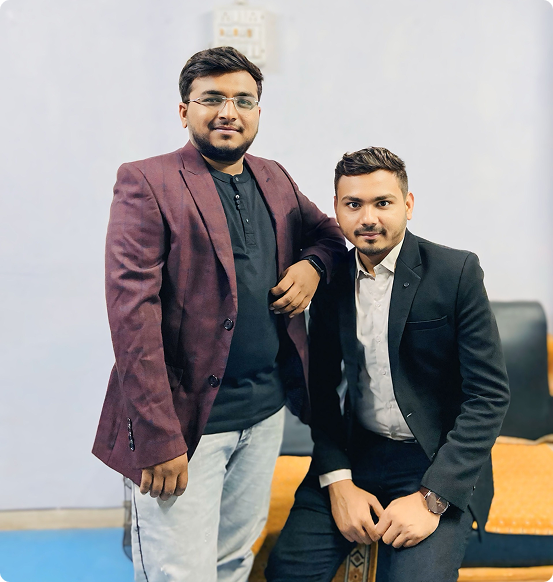
Some entrepreneurial journeys begin with a detailed business plan, significant funding and a clear roadmap. The story of Gahan Gosai and Jagdish Sorathiya began much more simply—with two college classmates who shared a fascination with entrepreneurship and a strong desire to build something of their own.
The two met on the very first day of college and soon discovered that they were interested in much more than academics. During their college years, they experimented with different startup ideas and explored what it really meant to create something from scratch. Not every idea worked, but every attempt gave them a better understanding of what entrepreneurship actually meant. They learned that an idea could look perfect on paper and still fail when introduced to the real world, and that building a product was only one part of the journey.
Most importantly, those early experiments created a mindset that would stay with them long after college: they did not simply want to participate in the startup ecosystem. They wanted to build something within it.
That ambition eventually became Mechodal Technology.
The Decision to Build
In 2021, Gahan and Jagdish decided to take their ambitions beyond experimentation and establish Mechodal Technology. Their vision was not simply to build another software development company, but to create a technology partner for entrepreneurs who had ideas for new businesses but needed the expertise and execution required to bring those ideas to life.
The beginning was challenging. The young founders had limited funds, limited experience in running a structured organization and no ready-made formula for building a company. Yet instead of waiting until everything was perfect, they started building immediately. Within their first month, they assembled a team of around 100 people, an experience that pushed them to learn leadership, operations and management at an extraordinary pace.
During those early days, Ashvin Patel, Founder of Milople, provided valuable support and guidance to the founders. His contribution helped Gahan and Jagdish navigate the uncertainty of their early entrepreneurial journey while they worked to turn their ambition into a sustainable organization.
Those difficult beginnings became an important part of Mechodal’s identity. They learned that building a company was not simply about having technical skills; it was about understanding people, businesses and the problems entrepreneurs were actually trying to solve.
From Building Software to Building Businesses
As Mechodal began working with more startups, Gahan and Jagdish noticed something that changed their perspective. Entrepreneurs were rarely looking for technology simply for the sake of technology. Behind every request for an application, website or software platform was a much larger ambition—a founder trying to launch a company, solve a market problem or create something that could grow.
That realization shaped Mechodal’s approach. The company began looking beyond the development project itself and focusing more closely on the business behind the product. Today, Mechodal works across mobile applications, websites, web platforms and custom software development, with a strong focus on helping startups transform ideas into working digital products.
For the founders, however, the most rewarding part is not simply completing a project. It is seeing something they helped build being used by real people. When an application moves from an idea on paper to a product with real users, it represents more than technology—it represents the beginning of a business.
Building With Startups, Not Just For Them
Over the years, Mechodal Technology has worked with around 150 startups and businesses. Its journey has also expanded beyond traditional client relationships into deeper partnerships with startups and ventures, including Renine Technologies, 4Bron Solutions, Prismech Technologies and Allkh Joli, among others.
The founders have also experienced startup exits and investment-related outcomes through ventures including Brihati Softtech and GraphicGlow Design. These experiences have strengthened their belief that technology can create significantly more value when it is connected to the long-term success of a business.
This is the difference Gahan and Jagdish want Mechodal to bring to the startup ecosystem. Rather than viewing themselves only as technology vendors, they aim to become partners who understand the founder’s vision, the product, the business model and the journey that follows after launch.
Two Founders, One Ambition
The partnership between Gahan and Jagdish is also defined by complementary strengths. As Founder and CEO, Gahan focuses on sales, marketing, business development, client acquisition and strategic growth. Jagdish, as Co-founder and COO, focuses on management, operations, strategy and team management.
Their responsibilities may be different, but their ambition is shared: to build a company that plays a meaningful role in India’s growing startup ecosystem. They believe the next generation of technology companies must go beyond delivering software. They must understand the entrepreneurs behind the software and help them navigate the journey from an idea to a functioning business.
Building What Comes Next
Today, Mechodal Technology operates from two locations in Gujarat and continues to work with startups and businesses looking to build technology-driven products. But for Gahan and Jagdish, the journey is far from finished.
Their long-term vision is to establish Mechodal as one of the leading names in India’s startup ecosystem—a company where entrepreneurs can bring an idea and find the technology, expertise and partnership required to take it forward.
What started with two college classmates experimenting with startup ideas has now become a much larger mission.
For Gahan Gosai and Jagdish Sorathiya, the goal is no longer simply to build software. It is to help build the businesses of tomorrow.