What does it mean to be a creative professional when artificial intelligence can generate an image in seconds, write a script in minutes and reshape the way ideas are brought to life?
For Deb Sarkar, founder of The Creative School (TCS), the answer is not to resist technology, but to understand how to use it without losing the human thinking that gives creativity its meaning.
A professional Video Editor, Creative Designer, Creator and Mentor, Deb Sarkar founded TCS with a vision that goes beyond teaching people how to operate creative software. Its tagline, “Building the Next Generation of Creative Leaders,” reflects a broader ambition: to develop people who can think critically, solve problems, adapt to change and turn ideas into meaningful work.
At the heart of that philosophy is a simple distinction: learning a tool is not the same as learning how to create.
A designer may know every feature of a design program and still struggle to develop an original concept. An editor may know how to cut footage without knowing how to tell a compelling story. A marketer may produce content without understanding what makes an audience stop, look and care.
So, what happens when a creator is given a problem rather than a set of instructions?
Can they research it, develop an idea, communicate a vision and execute it effectively?
That is where creative leadership begins.
The Creative School brings together graphic design, video editing, production, marketing and artificial intelligence, with an emphasis on practical skills and adaptable creative workflows. Rather than preparing students for one particular tool, TCS aims to prepare them for an industry in which the tools themselves are constantly changing.
Interestingly, the learning does not always begin in a classroom.
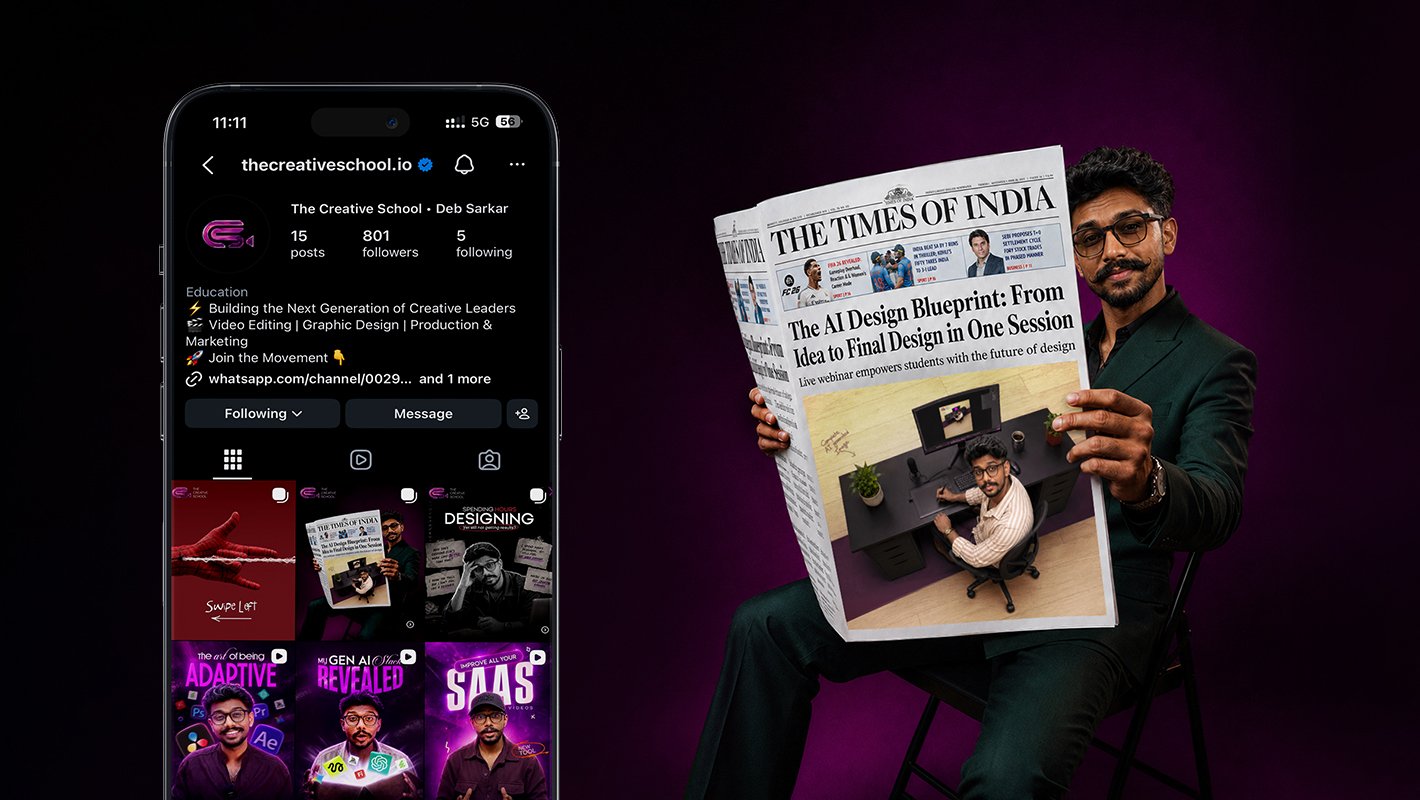
Through its Instagram platform, @thecreativeschool.io, TCS uses Reels, carousels and static posts to make creative education accessible through a medium its audience already understands. A creator scrolling through Instagram might encounter a design principle, production insight or AI workflow and immediately have something new to explore.
Sometimes education begins with a scroll, a question or a moment of curiosity.
But no conversation about the future of creativity can avoid artificial intelligence. Will AI replace designers, editors and other creative professionals?
TCS sees the technology less as a replacement and more as a creative accelerator. AI can help designers explore visual directions, assist editors with scripting and transcription, and help marketers research audiences and develop ideas.
But who decides which idea is worth pursuing?
Who understands the cultural context, the audience and the emotion behind a message? Who recognizes when something looks technically impressive but communicates very little?
That still requires human judgement.
This philosophy became part of TCS’s practical learning from the beginning. In June, the school hosted its first webinar, The Design Blueprint, an introductory session exploring the creative journey from idea to final design. Mentored by Deb Sarkar, the session offered participants a glimpse into how creative thinking and emerging technology can work together rather than compete.
The initiative reflects a broader approach TCS continues to develop through live webinars and educational sessions, where aspiring creators can engage with concepts in real time, ask questions and explore contemporary tools and workflows. These sessions turn learning from passive consumption into active participation.
The school is also developing a community through its WhatsApp channel, creating a space where learners can remain connected to upcoming sessions, initiatives and educational content.
Yet perhaps the most important part of creative education cannot be taught through a tutorial.
You have to make.
Creativity grows through experimentation, mistakes, feedback and repetition. It develops when learners stop simply watching other people create and begin producing, questioning and refining their own work.
That practical mindset is central to Sarkar’s role as a creator and mentor—and to TCS’s larger vision.
The challenge, however, is that nobody knows exactly what the creative industry will look like five years from now. Software will evolve. Platforms will shift. AI will become more sophisticated.
So, what should remain at the center of education?
For The Creative School, the answer lies in fundamentals that can withstand technological change: storytelling, composition, typography, color, communication, creative thinking and problem-solving.
The tools may change, but the ability to think differently does not have to.
Ultimately, The Creative School is not simply preparing creators to use today’s technology. It is preparing them to navigate tomorrow’s creative landscape.
Because when everyone has access to powerful tools, the real advantage may belong to those who know what is worth creating.
And perhaps that is the heart of TCS’s mission: not merely teaching people how to create, but helping them become the kind of creative thinkers who can decide what comes next.