
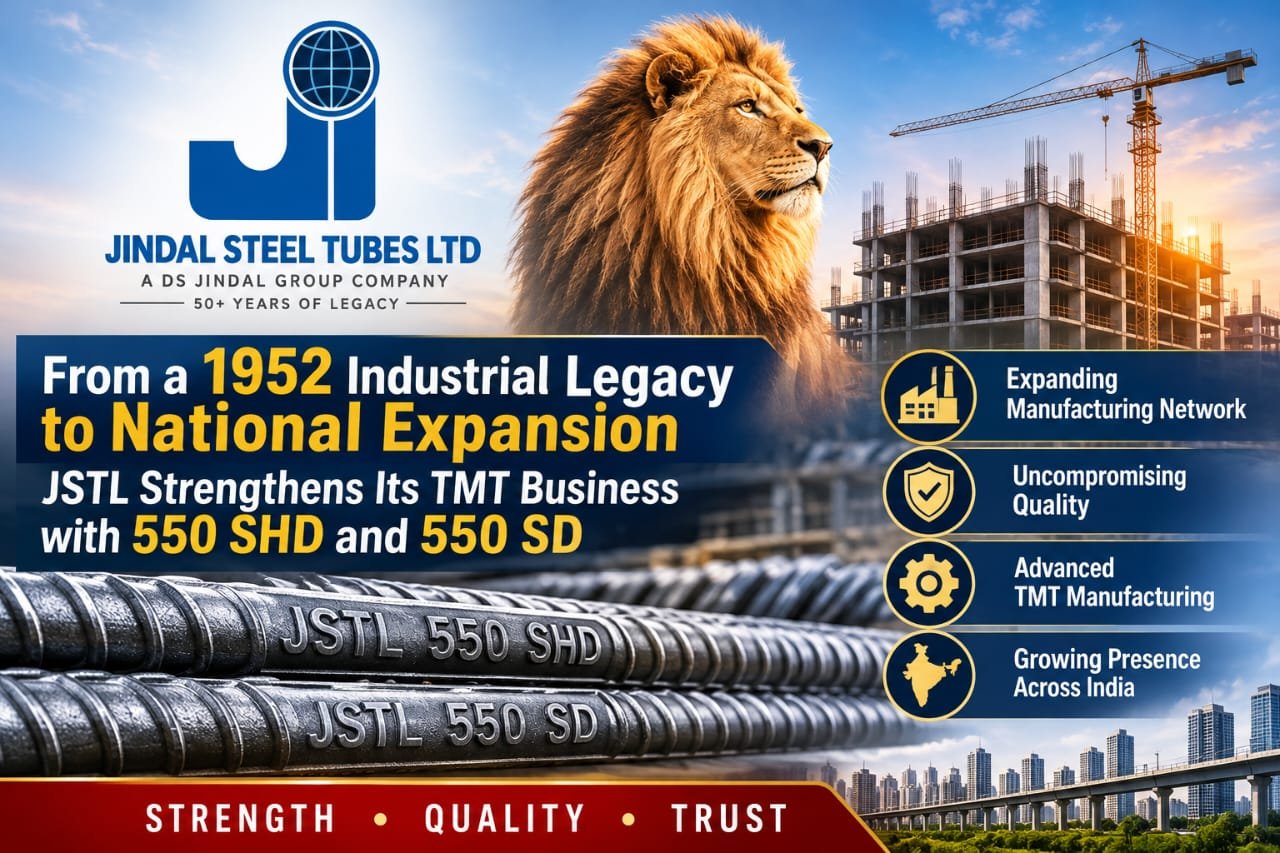
Backed by the industrial heritage of the DS Jindal Group, Jindal Steel Tubes Limited is expanding its TMT business with a focus on manufacturing partnerships, quality assurance, product development and a wider distribution network.
NEW DELHI: India’s growing construction and infrastructure sector continues to drive demand for steel products, placing greater emphasis on manufacturing capabilities, product quality and reliable supply networks. Against this backdrop, Jindal Steel Tubes Limited (JSTL) is expanding its presence in the TMT steel segment through its product portfolio, manufacturing network and market development initiatives.
The company’s JSTL 550 SHD and JSTL 550 SD TMT Bars are emerging as key products in its expansion strategy. Alongside manufacturing development, the company is also focusing on quality-related processes and strengthening its distribution ecosystem.
The expansion comes against the backdrop of the industrial legacy associated with the DS Jindal Group, which has a history of steel manufacturing dating back to 1952.
A Legacy Rooted in India’s Steel Industry
The industrial journey associated with the DS Jindal Group began in 1952, when Late Padma Shri Debi Sahai Jindal and his brothers established a Steel Works at Nalwa.
The early business was associated with the manufacturing of Mild Steel, ERW Pipes, Galvanised Pipes and Tubes. Over the years, the industrial business developed across different segments of the steel industry.
Debi Sahai Jindal was honoured with the Padma Shri in 1971 for his contribution to trade and industry.
Today, the steel industry is undergoing significant changes, driven by evolving construction requirements, technological developments and increasing expectations regarding product quality.
JSTL’s entry and expansion in the TMT segment reflect this changing industrial landscape, where manufacturing capabilities, product consistency and market reach are becoming increasingly important.
The company’s current business development is closely linked to the broader industrial heritage of the DS Jindal Group, while its TMT operations represent a newer phase of its business journey.
JSTL 550 SHD and 550 SD Expand the TMT Product Portfolio
JSTL is developing its presence in the TMT segment through products including JSTL 550 SHD and JSTL 550 SD.
TMT reinforcement bars are widely used in residential construction, commercial buildings and infrastructure projects. Their performance depends on several technical characteristics, including strength, ductility, chemical composition and compliance with applicable quality standards.
The development of the 550 SHD and 550 SD product portfolio reflects the company’s efforts to address different market requirements.
As the TMT business expands, product specifications, manufacturing consistency and quality verification are expected to remain important considerations for the company.
The technical characteristics of individual products are determined by their applicable specifications and relevant test reports.
Virgin Iron and Raw Material Quality in Steel Manufacturing
Raw material selection plays an important role in steel manufacturing and can influence the properties of the final product.
Virgin Iron-based raw materials may be used in steelmaking through different production routes. These can include iron units derived from primary sources, depending on the manufacturing process.
Virgin Iron and recycled steel scrap are technically different categories of raw material. However, the quality of finished steel is not determined by raw material selection alone.
The final properties of TMT bars depend on several factors, including raw material composition, steelmaking practices, billet quality, rolling parameters, thermo-mechanical treatment and quality control.
For JSTL, the use of Virgin Iron in the manufacturing of 550 SHD and 550 SD can be an important aspect of its product positioning, provided the specific raw material composition is supported by manufacturing records and technical documentation.
In an increasingly quality-conscious steel market, transparency regarding manufacturing practices and product specifications can play an important role in building customer confidence.
Understanding the TMT Manufacturing Process
The production of TMT reinforcement bars involves a series of metallurgical and manufacturing processes.
A typical TMT manufacturing process includes steelmaking, billet casting, reheating, rolling and thermo-mechanical treatment.
The process begins with the preparation of suitable raw materials and the production of molten steel. The molten steel is then cast into billets, which serve as the semi-finished material for rolling.
The billets are reheated to the required temperature and passed through rolling mills, where they are shaped into reinforcement bars of specified diameters.
The hot-rolled bars then undergo a controlled cooling process as part of thermo-mechanical treatment.
During this stage, rapid surface cooling followed by controlled cooling allows the bar to develop a combination of metallurgical properties across its cross-section.
The objective of the TMT process is to achieve an appropriate balance between strength and ductility, which is important for reinforcement steel used in construction.
The actual manufacturing route, equipment and process parameters may vary across facilities. Specific claims regarding JSTL’s manufacturing technology should therefore be based on the technical details of the relevant production facility.
Quality Assurance and Physical-Chemical Testing
Quality verification remains an important aspect of the TMT steel business.
For products such as JSTL 550 SHD and JSTL 550 SD, physical and chemical testing can help evaluate whether the finished product meets its applicable technical requirements.
Physical testing may include the assessment of mechanical properties such as tensile strength, yield strength and elongation.
Bend and rebend tests are also used to evaluate the ductility and behaviour of reinforcement bars under specified conditions.
Chemical testing is carried out to determine the chemical composition of steel and assess its conformity with applicable specifications.
Other quality-related checks, such as diameter measurement and weight verification, may also form part of the inspection process.
The actual testing requirements and results for a specific JSTL product must be established through the relevant test reports and applicable BIS standards.
As manufacturing operations expand across different locations, maintaining consistency in product specifications and quality verification becomes an important operational consideration.
Commercial Dispatch of JSTL 550 SHD Begins from Giridih
The commercial dispatch of JSTL 550 SHD TMT Bars began from Giridih, Jharkhand, on July 25, 2026.
The manufacturing facility operated by Lall Steels Private Limited became an important part of the company’s initial TMT supply network.
The development followed the business collaboration involving Jindal Steel Tubes Limited and Khyati Contech Private Limited.
Under the business framework, manufacturing partners are associated with production activities, while Khyati Contech’s role includes brand development, market development and distribution-related initiatives.
The commencement of commercial dispatch from Giridih marked an important stage in JSTL’s TMT business development.
Subsequent reports indicated an expansion of the manufacturing network, with additional facilities being associated with the JSTL 550 SHD programme.
A September 2026 report stated that the manufacturing network had expanded to more than 10 units.
However, the operational status of individual facilities may differ, with some locations engaged in production and others in commissioning or development.
JSTL 550 D Production and Dispatch Begins at Hindupur
A new development in JSTL’s manufacturing expansion has emerged from Hindupur, Andhra Pradesh.
According to information shared regarding the facility, the production and dispatch of JSTL 550 D TMT Bars have commenced at the Hindupur plant.
The development also highlights the importance of physical and chemical testing in the manufacturing process.
The commencement of production at Hindupur represents a new development in JSTL’s manufacturing network and provides an additional location for the production and supply of its TMT products.
The company’s 550 SHD and 550 D products are part of its broader TMT portfolio.
The Hindupur development is based on the production and dispatch information provided by the company-side source. Independent media verification of this specific development remains unavailable at present.
Manufacturing Network Expansion Across Multiple Locations
JSTL’s expansion is not limited to a single manufacturing location.
Reports published during August and September 2026 referred to the development of a wider manufacturing network, with references to six units, more than 10 units and subsequently more than 14 units.
These reports also indicated that manufacturing facilities were at different stages of operation, commissioning and development.
A manufacturing partnership-based model can enable companies to develop production capabilities closer to regional markets.
In the steel industry, the geographical location of manufacturing facilities can influence transportation costs, delivery timelines and product availability.
A wider manufacturing network may also help improve coordination between production and distribution, subject to the operational capabilities of individual facilities.
For JSTL, the development of a multi-location manufacturing network forms an important part of its broader market expansion strategy.
Distribution and Market Development
Alongside manufacturing, distribution remains a key component of the TMT steel business.
Khyati Contech Private Limited is associated with brand development, manufacturing partnerships, distribution and market development activities within the JSTL business framework.
The development of dealer and distributor networks is intended to support the availability of products across different construction markets.
In a business where manufacturing capacity and market demand must remain aligned, efficient coordination between production, inventory management and dispatch is important.
As the manufacturing network expands, maintaining supply consistency and ensuring that products reach customers in a timely manner will remain important operational considerations.
The Road Ahead
With the Indian construction and infrastructure sector continuing to evolve, JSTL is developing its TMT product portfolio and manufacturing network.
The industrial heritage associated with the DS Jindal Group, the development of JSTL 550 SHD and 550 SD, the reported commencement of 550 D production at Hindupur and the expansion of manufacturing partnerships represent key aspects of the company’s business journey.
However, the success of a manufacturing expansion programme is not determined by the number of facilities alone.
Production consistency, quality assurance, product availability and the effectiveness of distribution networks remain important factors in the long-term development of a steel business.
For JSTL, the coming period will be significant as the company continues to develop its manufacturing capabilities and market presence.
From the commercial dispatch of 550 SHD at Giridih to the reported commencement of 550 D production at Hindupur, the company’s TMT operations appear to be entering a new phase of development.
The next stage of JSTL’s journey will depend on how effectively it combines its industrial heritage with manufacturing capabilities, quality practices and a growing distribution network.