
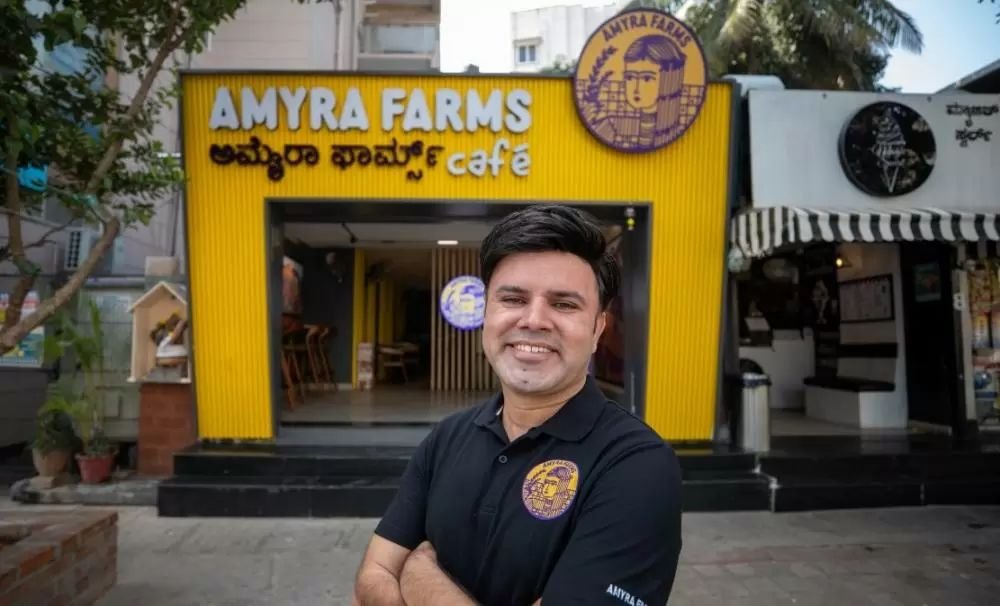
In the mist-covered hills of Chikmagalur and Sakleshpur, a different kind of coffee farming is taking root — one that challenges the false binary between productivity and sustainability that has long divided Indian agriculture.
Sandeep Chaudhary is not a fourth-generation planter with inherited wisdom, nor a weekend farmer with urban capital to burn. He came to coffee from the technology sector, with no agricultural background and no family land. What he brought instead was a question that few in the industry were asking: why must Indian coffee farmers choose between yields and soil health?
Over the past several years, working across two estates in Karnataka’s coffee belt, Chaudhary has been developing an integrated farming model that treats the plantation as a living system rather than a production unit. Coffee grows alongside pepper, cardamom, and cocoa. Gir cattle provide both dairy income and the biological inputs that feed the soil. Biogas infrastructure turns waste into energy. Each element supports the others.
The approach draws heavily from India’s own agricultural research institutions — particularly the Central Coffee Research Institute — but translates that science into practical field protocols that working farmers can adopt. “The research exists,” Chaudhary observes. “The gap is in implementation. Most farmers don’t have time to read journals. Someone needs to bridge that distance.”
That bridging work has become central to his contribution. Beyond his own estates, Chaudhary is documenting regenerative coffee practices in systematic detail — creating resources that could help other growers transition away from input-intensive methods without sacrificing their livelihoods. A comprehensive guide on the subject is currently in development.
What distinguishes this work is its rejection of ideology. In an era when agricultural discourse often splits into opposing camps — chemical versus organic, traditional versus modern — Chaudhary’s model is resolutely pragmatic. Decisions are driven by soil biology, plant health indicators, and economic viability, not by slogans.
The stakes extend beyond any single farm. Indian coffee, though renowned for quality, faces mounting pressures: climate variability, rising input costs, labour shortages, and the steady migration of young people away from agricultural livelihoods. Models that demonstrate both ecological resilience and financial sustainability are not academic exercises — they are existential necessities for the sector’s future.
For Chaudhary, the goal is not personal recognition but proof of concept. “If this works at scale, it should be replicable,” he says. “That’s the only measure that matters.”
In Karnataka’s coffee country, that proof is quietly taking shape — one harvest, one season, one carefully observed intervention at a time.