What if accessibility was not an adjustment—but the starting point of design?
For decades, accessibility in travel has existed as a promise rarely fulfilled. Hotels claim to be “accessible” but lack functional design. Websites list destinations that cannot be navigated. Experiences are curated for the average traveller, quietly excluding millions who do not fit that mold. In the hills of Chamba, a small but significant shift is underway.
Accessibility startup Inqlude has partnered with experiential travel platform NotOnMap to launch what it describes as India’s first AI-enabled, fully inclusive travel experience. This move is not a privilege but a much required standard of inclusivity.
Moving beyond “accessible on paper”
The Indian tourism sector has grown rapidly, but accessibility has not kept pace. What exists today is fragmented—isolated ramps, inconsistent infrastructure, and digital platforms that often fail at the first interaction.
For travellers with disabilities, exclusion rarely begins at the destination. It begins earlier. At the stage of search. Websites that cannot be read by screen readers, booking interfaces that are not navigable, information that is incomplete or visually dependent. By the time the journey reaches the “experience” stage, many potential travellers have already been filtered out.
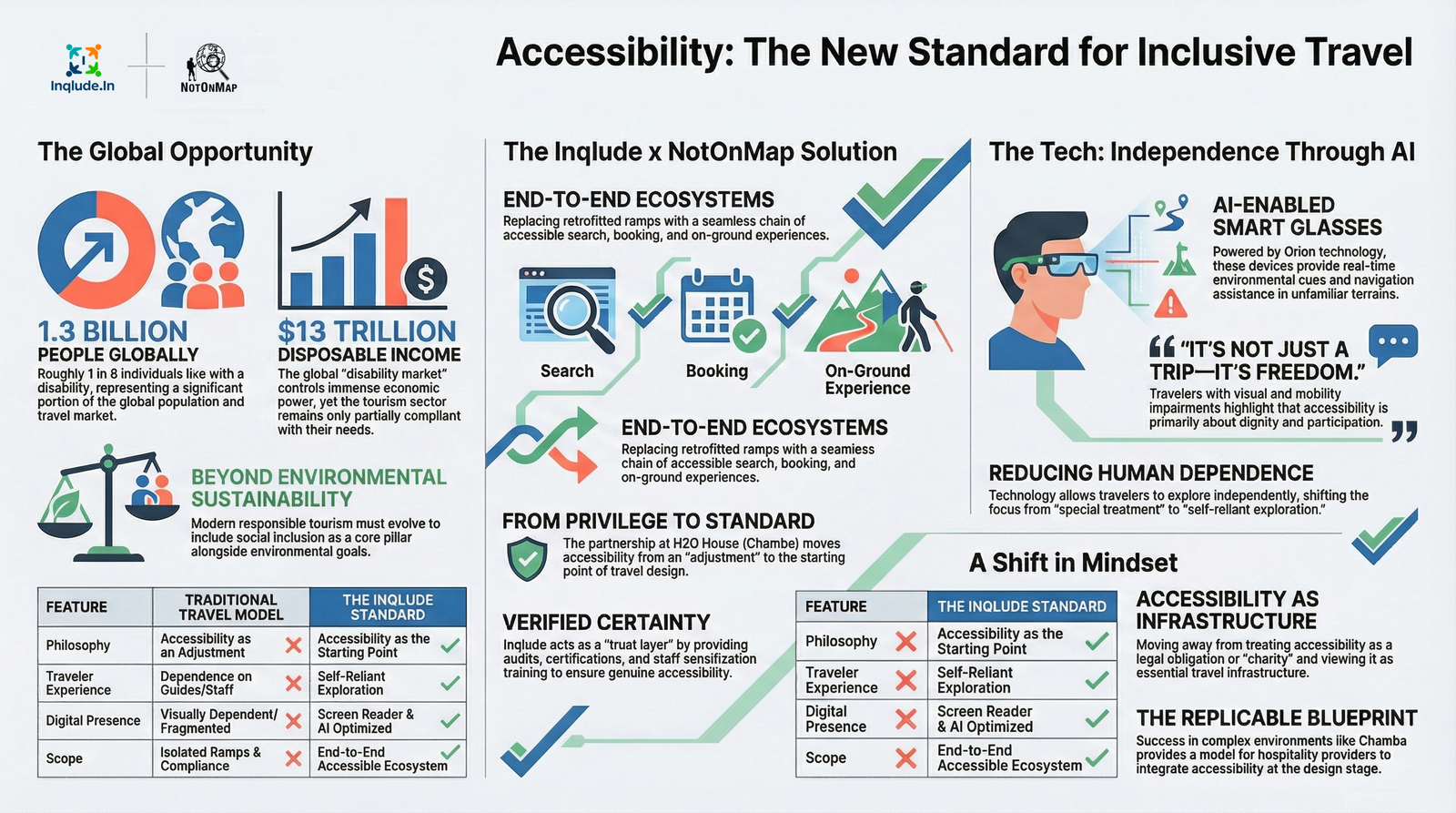
Inqlude’s approach challenges this entire chain where instead of retrofitting accessibility into existing systems, the startup is building end-to-end accessibility ecosystems—where digital interfaces, physical spaces, and on-ground experiences are aligned.
The collaboration: Technology meets travel design
The partnership with NotOnMap brings together two complementary strengths: accessibility infrastructure and immersive travel curation.
At H2O House, this translates into a travel experience that is not just “inclusive in intent,” but structured for usability.
The defining feature of this initiative is the integration of AI-enabled smart glasses, powered by Orion technology and built around Inqlude’s proprietary accessibility guidelines.
These devices are designed to provide:
- Real-time environmental cues
- Navigation assistance in unfamiliar terrains
- Contextual information about surroundings
- Reduced dependence on external human assistance
The result is not simply convenience, but something more fundamental: independence.
A global gap backed by data
The urgency of accessibility is not anecdotal, it is measurable. According to the World Health Organization, over 1.3 billion people globally—roughly 1 in 6 individuals—live with some form of disability. When families and dependents are included, the number of people directly impacted by accessibility rises significantly.
In economic terms, the “disability market” is estimated to control over $13 trillion in annual disposable income globally. Yet tourism continues to lag behind.
A 2022 report by the World Tourism Organization (UNWTO) highlights that while accessible tourism is one of the fastest-growing segments globally, most destinations remain only partially compliant, with gaps in information, infrastructure, and service delivery.
Reimagining the travel experience
What distinguishes this initiative is not just the use of technology, but the attempt to rethink how travel is experienced. Traditional travel models assume dependence: on guides, on companions, on assistance. Inqlude’s model moves in the opposite direction—towards self-reliant exploration. Consider what this could mean for different travellers:
“I’ve always loved the idea of mountain travel, but never the logistics around it,” says a traveller with visual impairment. “If something like this allows me to navigate independently, it’s not just a trip—it’s freedom.”
“Most so-called accessible stays require you to depend on staff constantly,” notes another user with mobility challenges. “A system that reduces that dependence changes the experience completely.”
“It’s not about special treatment,” adds a third. “It’s about being able to participate without planning your entire trip around limitations.”
These voices reflect a widely documented reality: accessibility is as much about dignity as it is about design.
From pilot to blueprint
The choice of H2O House in Chamba is deliberate. Rather than launching in a controlled urban setting, the initiative tests accessibility in a more complex, real-world environment. If successful, it offers a replicable model.
For hospitality providers, this could mean:
- Integrating accessibility at the design stage
- Leveraging AI tools for real-time assistance
- Standardising user experiences across properties
For tourism boards, it presents a framework for aligning accessibility with responsible tourism goals—moving beyond sustainability as an environmental concept to include social inclusion.
The larger vision
For Inqlude, this project is not an isolated experiment. It is part of a broader ambition to make accessibility a default standard across industries. The company has already been working on digital accessibility—auditing websites, improving mobile app usability, and creating accessible documents. Its long-term strategy includes developing proprietary accessibility guidelines, which it plans to make openly available to encourage adoption across sectors. The travel initiative represents an extension of that philosophy into physical spaces.
Founder Rajan Rai frames it as a shift in mindset:
“Accessibility has always been treated as an obligation. We see it as infrastructure. This collaboration is an attempt to show what becomes possible when accessibility is designed from the ground up.”
A subtle but important shift
The significance of this project lies not in scale, but in direction. It suggests that the future of travel may not be defined solely by luxury, sustainability, or experience—but by who gets to participate in it.
If accessibility becomes embedded at the design stage—across websites, booking systems, and destinations—it could fundamentally alter how industries think about users. Not as a uniform category, but as a spectrum of needs.
Conclusion: From exception to expectation
For now, H2O House remains a single destination. But its implications extend far beyond Chamba. If initiatives like this succeed, accessibility will no longer be marketed as a feature. It will be expected as a baseline. And when that happens, the question will no longer be whether a place is accessible—
but why it ever wasn’t.
About Include:
Inqlude is a DPIIT-registered startup dedicated to bridging the information and infrastructure gap in the tourism sector. Our mission is to make travel accessible and independent. We move beyond simple sympathy or providing a “helper”; instead, we transform the environment itself—infrastructure, digital interfaces, and human interactions—so that every traveler, regardless of visual, hearing, mobility, or intellectual ability, can explore the world on their own terms. We are not just a travel agency; we are an ecosystem builder. From auditing hotels and heritage sites like UNESCO monuments to providing staff sensitization training, we ensure that the joy of travel is truly universal.