
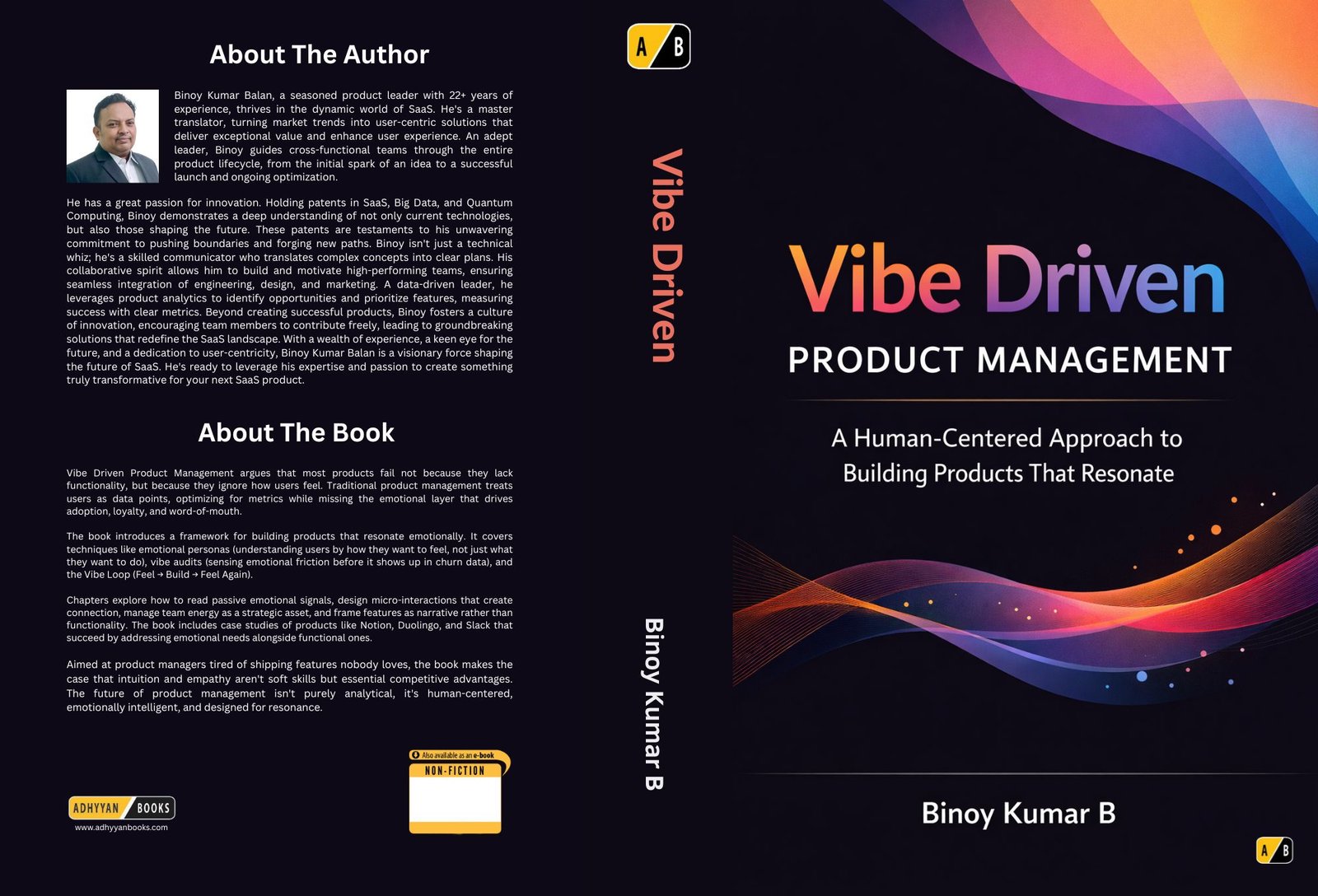
A new publication titled “Vibe Driven Product Management: A Human-Centered Approach to Building Products that Resonate” by Binoy Kumar presents a structured argument for rethinking how products are conceptualised and delivered in contemporary digital ecosystems.
At a time when product development is increasingly guided by quantitative metrics and automation, the book underscores the importance of incorporating qualitative, human-centric considerations into decision-making. It introduces the concept of “vibe” as a composite of usability, contextual relevance, emotional alignment, and experiential coherence—factors that, while difficult to quantify, significantly influence product adoption and long-term engagement.
Reframing Product Development Beyond Metrics
The author contends that while key performance indicators such as conversion rates, retention, and engagement remain critical, they often reflect outcomes rather than root causes. According to Binoy Kumar, sustainable product success depends on a deeper understanding of user intent, behavioural patterns, and contextual usage.
The book proposes that product managers and organisational leaders must move beyond purely data-driven approaches and integrate intuitive judgment, grounded in user empathy and real-world interaction, into their strategic frameworks.
Enterprise Insights Informing the Framework
Drawing upon extensive experience across SaaS platforms, enterprise resource planning (ERP) systems, financial applications, and supply chain solutions, the publication highlights recurring challenges in product adoption within large organisations. These include complexity in user interfaces, misalignment with operational workflows, and insufficient attention to user behaviour.
Through a series of structured frameworks and practical illustrations, the book seeks to address these gaps by offering:
• Approaches to identify and evaluate product “vibe”
• Methods to align product design with user context and behaviour
• Leadership perspectives on managing product teams in complex environments
• Case-based insights derived from enterprise implementations
Relevance in the Context of AI-Led Transformation
With the increasing integration of artificial intelligence and automation in product development, the book emphasises the continuing importance of human judgement. It argues that while algorithmic systems can optimise decisions, they cannot fully replicate the nuances of human perception and experience.
The author positions the proposed approach as complementary to existing data-driven methodologies, rather than a replacement, advocating for a balanced model that combines analytical rigour with human-centric insight.
Implications for India’s Expanding Product Ecosystem
India’s growing presence in the global SaaS and digital product landscape provides a relevant backdrop for the ideas presented in the book. As organisations seek to differentiate themselves in competitive markets, the ability to design products that resonate with users at both functional and experiential levels is expected to gain increasing importance.
Industry practitioners note that frameworks emphasising user-centricity and contextual design could contribute to improved product adoption and customer satisfaction, particularly in enterprise and mid-market segments.
About the Author
Binoy Kumar is a senior product management leader with over two decades of experience in enterprise software, including SaaS, ERP, financial systems, and supply chain platforms. He has been involved in driving product strategy and innovation across multiple markets and holds several patents in technology domains.