How Brijesh Chandra Srivastava Built a Knowledge Pavilion, Books, a Channel, and an App, and Chose to Give Most of It Away
There is a question every seasoned professional eventually faces near the end of a long career: what happens to everything they’ve learned, once they stop working. Most let it retire with them.
Brijesh Chandra Srivastava chose a different answer.
An IIT Roorkee alumnus with nearly four decades of experience across railway infrastructure, metro systems, bridges, and large civil engineering projects, Srivastava spent his career solving problems on the ground before he began writing about them. Since retirement, that experience has taken the form of four published books, two of which have received national literary recognition, and a knowledge platform built under BridgeMind Consulting called Cerebral Pursuits. Together, the books, a YouTube channel, and a companion app form what Srivastava refers to as a Knowledge Pavilion, three separate entry points into the same body of work.
His debut, Awareness to Mastery: The HCF of Every Great Exam, approaches competitive examination preparation from an angle most coaching institutes overlook, not strategy or syllabus coverage, but the cognitive discipline, sustained attention, and composure under pressure that determine whether a well-prepared candidate performs on the day it counts. Written for JEE, NEET, UPSC, and CAT aspirants, the book earned a national literary award and has been featured on IIT Roorkee’s official platforms. For UPSC aspirants specifically, it functions as a companion volume to his second book, Beyond the Syllabus, which addresses strategy directly, the two books built to work together, one training the mind, the other training the approach.
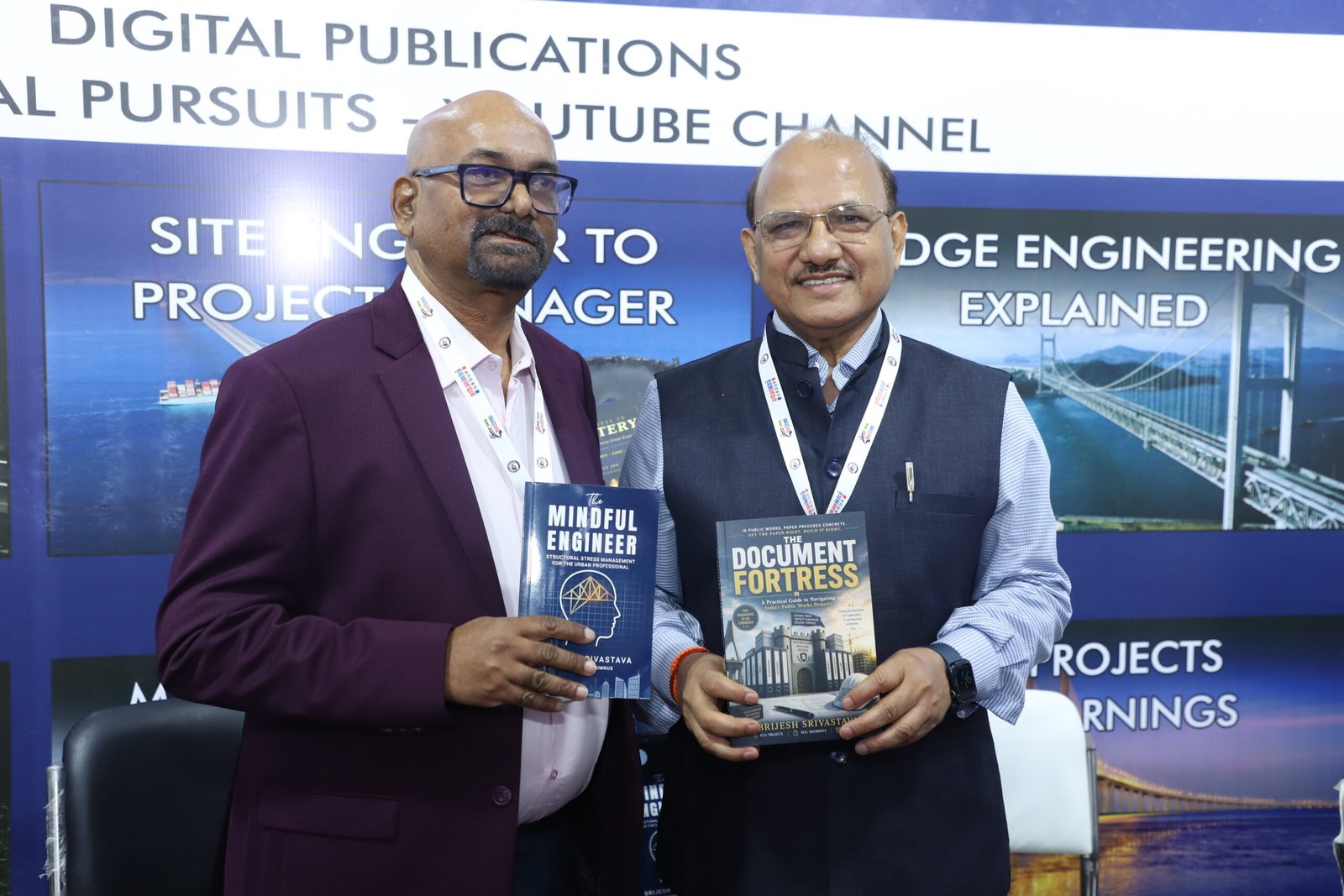
The Document Fortress, his third book, was recognised nationally for excellence in professional non-fiction. It addresses a subject rarely written about at book length, the documentation discipline that determines whether infrastructure projects survive audits and disputes.
Srivastava believes knowledge has its highest value only when it is transferred before retirement, not archived after it. Much like engineering drawings that must be handed over before a project is commissioned, he argues, professional wisdom too must outlive the person who accumulated it. That conviction has quietly become the foundation of every initiative under BridgeMind. The books, the channel and the app are not a portfolio of products, but a single, ongoing act of knowledge transfer.
That thinking is most visible in The Mindful Engineer, his fourth book, which turns toward the professionals building India’s infrastructure directly. Unlike conventional stress-management books, it focuses on techniques that can be applied between meetings, site visits, and project deadlines, brief, practical interventions that do not require a major lifestyle change, aimed at a workforce for whom stress is common but rarely discussed openly.
All four books have been recognised by the Institution of Engineers India and the Chamber of Railway Industries, and have been featured on IIT Roorkee’s official website and across its social media platforms, an uncommon distinction for a self-published author writing outside any institutional imprint.
The books are commercially available on Amazon. They are also, frequently, given away. Srivastava has personally handed out copies at exhibition stalls, construction offices, and alumni gatherings, often to young engineers he judges could use the guidance more than they could spare the cost. “If a book only reaches people who can already afford it,” he says, “it has failed the very people it was written for.”
The same instinct runs through the Cerebral Pursuits YouTube channel, which is free to access and has, in recent months, focused on explaining the 616-page Indian Railways Construction Manual (IRCM) to working engineers who, according to Srivastava, typically consult the manual only after a problem has already occurred. The channel has drawn attention from within the institution that produced the manual itself. The former Director General of IRICEN has commented publicly on the series twice, calling out its emphasis on proactive planning over reactive monitoring. During a recent visit to Northern Railway’s Construction Office in Lucknow, Deputy Chief Engineers who had already found the channel independently asked Srivastava to expand it further, into topic-wise explainers on bridges, track systems, prestressed concrete, and quality control, now reportedly in development.
The Cerebral Pursuits app, available on the Google Play Store, is a paid extension of the same initiative, carrying nominal charges for structured courses. Srivastava does not describe this as charity, nor does he claim the venture is not commercial. “People buy books, people enrol in courses, and that sustains what we do,” he says. “But the moment the goal becomes the sale instead of the knowledge, the whole thing stops meaning anything.” The distinction, he argues, is one of sequence rather than purity: dissemination comes first, revenue is what allows it to continue, not the reason it began. The app currently offers foundational content for junior-class students building toward IIT-level readiness, marketed under the phrase “Train the Brain, that solves the problems,” alongside courses for young civil engineers and working professionals. Additional modules, including topic-wise IRCM courses and structured career-guidance content, are in development.
At RailTrans Expo 2026, held at Bharat Mandapam in New Delhi, Srivastava’s BridgeMind Knowledge Pavilion drew a different crowd than the rolling stock and AI platforms surrounding it. Retired Railway Board members read his books on the spot. A Chamber of Railway Industries delegation presented BridgeMind with a memento on stage. “Engineers came for machinery,” Srivastava says. “Some left with a knowledge subscription instead.”
BridgeMind Consulting, the Lucknow-based enterprise Srivastava founded to formalise decades of field experience into structured advisory and mentorship, operates on a guiding principle he states plainly: clarity precedes correctness. Infrastructure projects, in his assessment, rarely fail because of poor engineering. They fail in the space between design and execution, where decisions are delayed and understanding is incomplete, the same gap his books, channel, and app are built to narrow.
“I spent nearly four decades learning what goes wrong on a site,” Srivastava says. “None of this is about building a brand. It is about making sure the next engineer inherits what took me a lifetime to understand, without paying for it in the same mistakes I made.”
Whether through books, lectures, digital courses, or conversations at an exhibition stall, Srivastava appears to be pursuing the same objective: ensuring that decades of engineering wisdom do not retire with the engineer.
Learn more
Website
www.thebridgesh.com | bridgemind360.com
YouTube
Cerebral Pursuits (search on YouTube), app available on Google Play
Books
Awareness to Mastery, Beyond the Syllabus, The Document Fortress, The Mindful Engineer, available on Amazon