
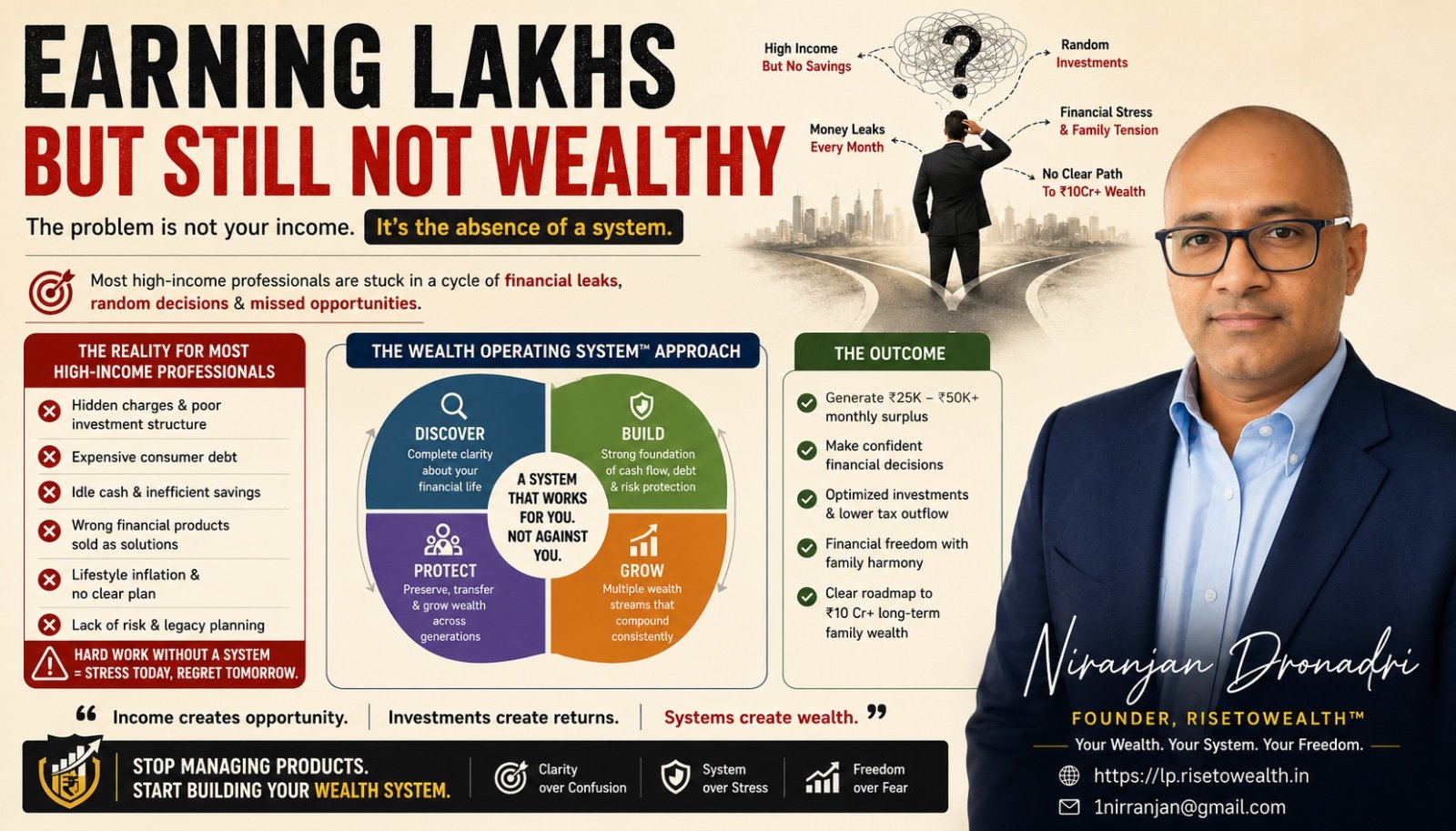
By Niranjan Dronadri, Founder, RiseToWealth™
India is creating more wealth than ever before. Surgeons are building world-class practices, entrepreneurs are scaling businesses globally, and technology leaders are driving innovation across industries. Yet behind this remarkable progress lies a paradox that deserves greater attention.
Many of India’s highest-paid professionals still struggle to build lasting financial security.
This is not because they lack intelligence, discipline, or earning potential. In many cases, they have access to the best financial products, experienced advisors, and diverse investment opportunities. The challenge is more fundamental. They are managing individual financial products instead of managing an integrated financial system.
For decades, financial success has been associated with higher income, larger investment portfolios, and ownership of multiple assets. While these milestones matter, income alone has never guaranteed long-term prosperity. Many successful professionals quietly ask the same questions: Why doesn’t my net worth reflect my earnings? Am I making the right financial decisions? Will my family remain financially secure if life takes an unexpected turn?
The answers rarely lie in finding another investment product.
They lie in understanding how every financial decision works together.
Consider a modern hospital. It is not recognised for excellence because of one outstanding surgeon or one advanced MRI machine. It succeeds because diagnostics, surgery, nursing, pharmacy, administration, and technology operate as one coordinated system. Personal finance is no different. A collection of good investments, insurance policies, loans, and tax-saving instruments does not automatically become a good financial strategy unless every component is working towards a common objective.
One of the most overlooked challenges in personal finance is what I call financial leakage. These are the silent inefficiencies that gradually reduce long-term wealth without attracting attention. Hidden costs in investment portfolios, inefficient debt structures, idle cash, overlapping insurance policies, lifestyle inflation, and behavioural decisions made during market volatility can collectively have a far greater impact than most investors realise. Improving financial outcomes is often less about chasing extraordinary returns and more about eliminating these structural inefficiencies.
Equally important is behaviour. Markets rise and fall, but human emotions often determine financial outcomes. Investors panic during corrections, chase returns during market rallies, postpone estate planning, delay important financial decisions, or continue with outdated strategies simply because they have become comfortable. Sustainable wealth is built not only through sound investments but through disciplined decision-making supported by a repeatable framework.
This belief eventually led to the development of the Wealth Operating System™, a systems-thinking approach to wealth creation. Rather than focusing on individual financial products, it brings together four essential capabilities: understanding one’s complete financial position, building a resilient financial foundation, creating sustainable long-term growth, and protecting wealth for future generations. The objective is simple. Every financial decision should support every other financial decision.
My professional journey has taken me through Money Management, Agile transformation, financial markets, and authorship. Although these disciplines appear unrelated, they all reinforced one lesson: sustainable outcomes are rarely accidental. Whether building technology platforms or creating long-term financial resilience, success comes from well-designed systems, disciplined execution, and continuous improvement. This philosophy also inspired my books on technology, leadership, finance, and professional growth, all centred on helping individuals think more systematically about success.
India is entering a defining decade of economic growth. More professionals will earn well, invest more, and create greater opportunities for their families than any previous generation. The next evolution in personal finance, however, will not come from discovering another investment product. It will come from helping professionals build financial systems that are resilient, integrated, and aligned with their life goals.
For years, we have measured financial success by income. Perhaps the next decade should measure it differently, by how effectively professionals transform their earnings into enduring family wealth.
After all, wealth is not built by income alone.
It is built by systems.
About the Author
Niranjan Dronadri is the Founder of RiseToWealth™ and the creator of the Wealth Operating System™, a structured approach to helping professionals build long-term financial resilience through systems thinking. With experience spanning technology leadership, Agile transformation, financial markets, and wealth education, he has authored multiple books on technology, leadership, finance, and personal growth. His mission is to help professionals move beyond fragmented financial planning and build integrated wealth systems that create lasting generational wealth.
Connect with Niranjan Dronadri
Email:1nirranjan@gmail.com
WhatsApp: +91 9003075258
Website:https://lp.risetowealth.in
LinkedIn:https://www.linkedin.com/in/nirranjan1/