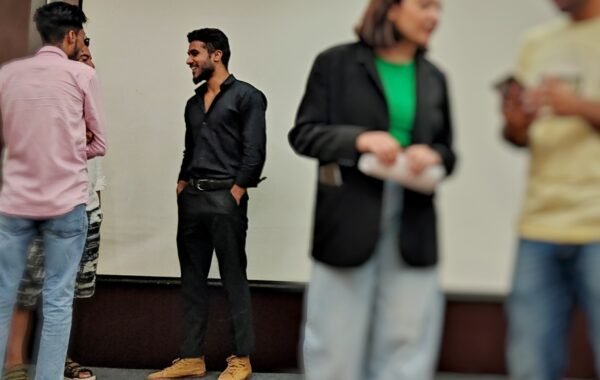
He is not positioned as a conventional designer driven by seasonal aesthetics or trend cycles; his approach is rooted in structural thinking—where clothing is treated as a tool to engineer perception, authority, and presence.
His core philosophy rejects the surface-level understanding of fashion. He emphasizes that the “frame” of an individual—body proportions, posture, personality, and psychological imprint—holds greater significance than the fabric itself. In his system, garments are not decorative elements but calculated extensions of identity. This thinking places him closer to an image strategist than a traditional fashion professional.
His passion lies in decoding how individuals are perceived and then reconstructing that perception through precise wardrobe engineering. This includes deep analysis of proportion, silhouette balance, color behavior against skin tone, and the psychological impact of structured dressing. His work often integrates principles of enclothed cognition—the idea that clothing directly influences mental state and behavioral output.
Through HSM Atelier, his premium fashion consultation and customization space, he has built a practice that prioritizes consultation over mere production. Clients are not sold garments; they are taken through a process of identity refinement. Each project becomes a study of the individual—profession, lifestyle, emotional disposition, and social positioning—translated into a wardrobe that communicates authority, clarity, and intent.
His vision extends beyond individual styling. He aims to redefine how fashion is understood in a broader cultural and professional context. This includes building systems, frameworks, and educational platforms that shift fashion from an aesthetic industry into a discipline of applied psychology and structured design thinking. His proposed academy reflects this direction—focused on producing image strategists rather than designers.
Parallel to his bespoke work, his ready-to-wear initiative reflects his commitment to precision at scale—where even seemingly simple garments are engineered with intent, proportion control, and functional clarity.
His impact is seen in how clients begin to perceive themselves differently. The transformation is not limited to appearance; it alters confidence, decision-making, and social presence. His work challenges the conventional narrative of fashion as expression alone and repositions it as a tool of authority and controlled identity projection.
In essence, Sreenath Mikhael operates as a system builder within fashion—constructing methodologies that turn clothing into a disciplined language of power, rather than an act of decoration.