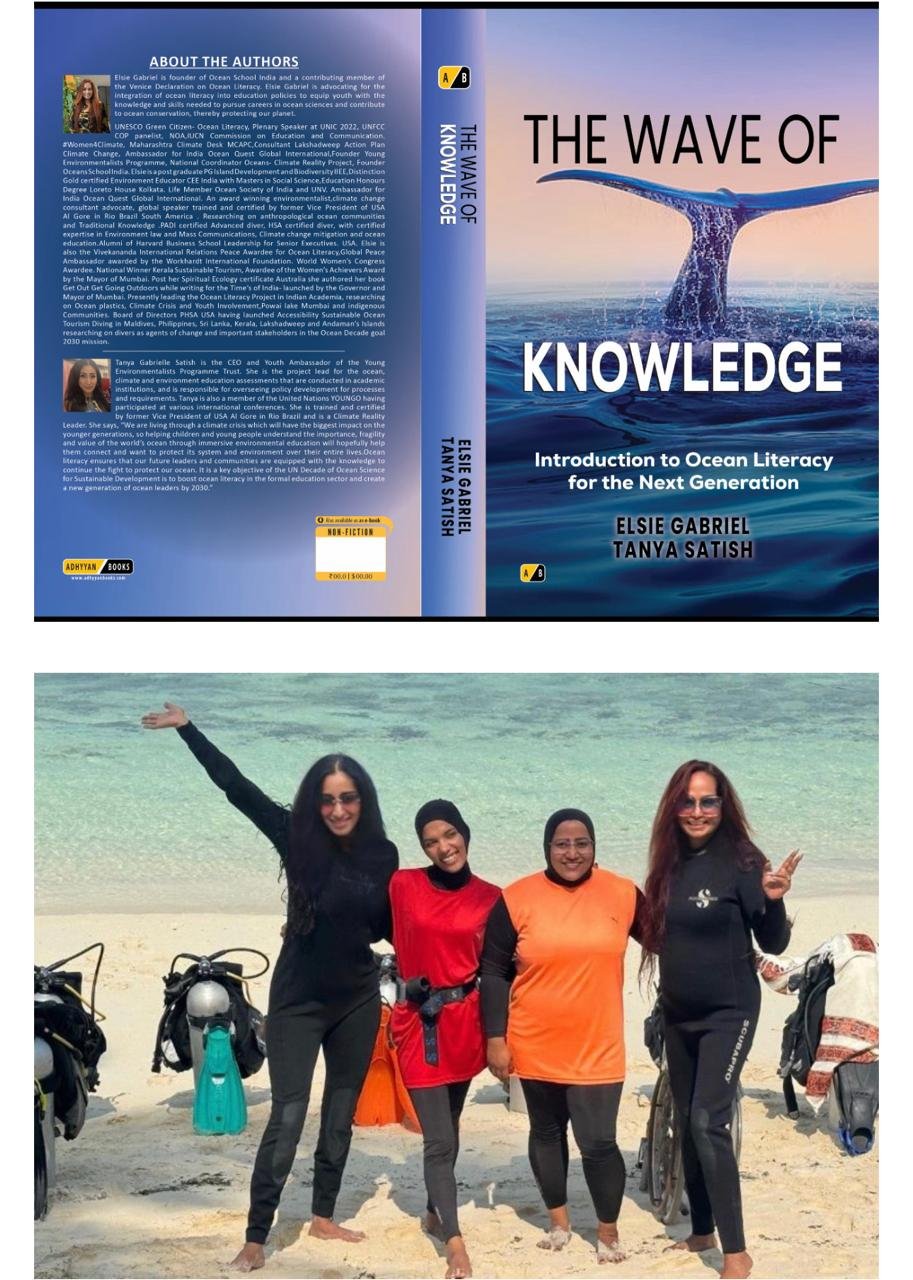
All over the globe,as governments, educators, and industries accelerate efforts toward the 2030 sustainability agenda, a new book is reframing how the world understands its relationship with the sea. Waves of Knowledge: An Introduction to Ocean Literacy, authored by Elsie Gabriel and Tanya Satish, argues that the future of marine conservation depends not only on science—but on who gets to participate. The book also reaches out to get citizen scientists involved to help reach the SDG goal as well as become a policy. The book has its foreword by the Governor of Maharashtra supporting ocean literacy.
Positioning ocean literacy as a bridge between research, education, community engagement, and inclusive opportunity, the book invites readers far beyond coastal regions into the conversation. Its central premise is simple yet urgent: humanity cannot protect what it does not understand, and understanding must be accessible to all.
From Awareness to Agency
Opines Elsie , “Around the world, millions of young people grow up without direct exposure to the ocean. Yet their lives are shaped daily by marine systems that regulate climate, influence rainfall, support food chains, and drive economies. We want to bring the oceans to the classrooms.”
Waves of Knowledge transforms this distance into connection.
Through clear explanations and practical frameworks, Gabriel and Satish provide tools for educators, families, institutions, and companies to bring the ocean into classrooms, boardrooms, and neighborhoods. Rather than presenting environmental decline as overwhelming, the authors emphasize pathways for participation, employment, innovation, and leadership.
Ocean literacy becomes not simply knowledge—but agency.
Leadership Rooted in Experience-
The authors behind the book stems from decades of hands-on engagement across global and grassroots platforms.
Gabriel, a researcher in Accessible Ocean Tourism and Ocean Literacy, is internationally known for advancing inclusion within marine environments. Her work spans adaptive diving, youth training, and policy advocacy, ensuring that differently abled individuals are recognized as contributors to conservation, not merely observers. She has played roles in the international Venice declaration on Ocean Literacy, youth ocean networks, and multi-stakeholder collaborations that align with the Sustainable Development Goals.
Her message, echoed throughout the book, is direct:
Continues Elsie,-“Global targets will remain out of reach unless participation widens.”
Satish brings complementary expertise in climate communication and institutional mobilization. Trained in leadership programs as a Climate Reality leader trained by former vice president of USA, Al Gore, she connect science with civic responsibility, she has worked with corporations, academic institutions, and international forums to translate environmental urgency into structured action. Her contribution ensures the book resonates not only emotionally but operationally.
Together, the authors connect policy rooms to playgrounds, coastlines to classrooms.
Inclusion as the Engine of Sustainability-
A defining feature of Waves of Knowledge- Ocean Literacy is its treatment of accessibility. Disability inclusion is not presented as an add-on or special interest; it is integrated as a strategic necessity.
By highlighting adaptive divers, neurodiverse learners, and youth from underserved geographies, the book challenges traditional narratives of who can be an environmental steward. Inclusive design, accessible communication, and equitable opportunity are shown to strengthen—not complicate—conservation outcomes.
For corporations and city planners, this approach aligns directly with evolving expectations around ESG performance, CSR implementation, and social impact metrics.
Inclusion multiplies reach.
Reach multiplies change.
A Resource for Multiple Audiences-
Unlike many environmental texts that sit exclusively within academia, Waves of Knowledge was written to travel.
Teachers can build curriculum pathways from it.
Students can discover careers previously unimaginable.
Companies can shape community engagement strategies.
Communities can rethink daily choices.
By maintaining scientific credibility while remaining readable, the authors expand the circle of confidence around ocean issues.
Economic and Social Opportunity-
The book also highlights an often-overlooked dimension: ocean literacy as a driver of workforce development. From marine biology and coastal management to sustainable tourism and climate services, future employment landscapes will demand interdisciplinary awareness.
When youth—including those from inland and marginalized communities—gain exposure early, career pipelines diversify. Innovation follows.
In this way, education becomes both environmental strategy and economic planning.
A Shared Ocean, A Shared Responsibility
Although written from India, the narrative speaks unmistakably to global readers. Its partnerships, examples, and aspirations cross borders, reinforcing the idea of one interconnected ocean.
Throughout the book, urgency is balanced with optimism. The crisis is real, but so is the capacity for collective action. Youth are not too small. Communities are not too distant. Businesses are not peripheral.
Everyone has a role.