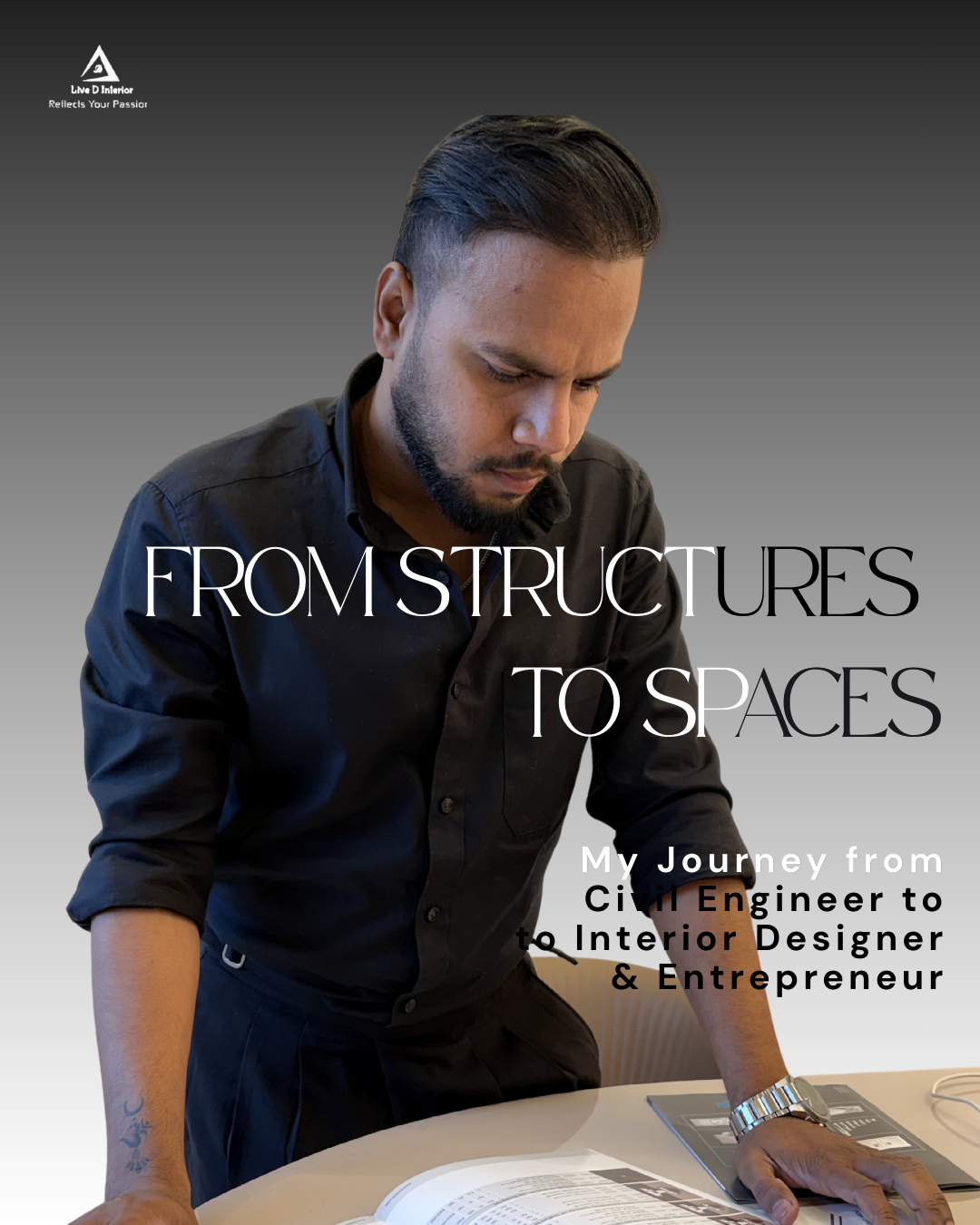
The built environment industry often begins with structure—foundations, beams, load-bearing walls, and construction schedules. For me, the journey started exactly there. As a civil engineer, my early professional years were focused on understanding structural systems, site coordination, and the technical discipline required to bring buildings to life.
But over time, one thought kept returning to me: what truly defines the experience inside these structures once construction is complete? Buildings may stand strong because of engineering, but it is design and spatial planning that shape the way people live, work, and interact within them. That realization became the turning point in my professional journey.
Civil engineering taught me to think structurally—to understand materials, durability, and construction processes. Interior design, however, introduced another dimension: human experience within space. While engineering focuses on structural integrity, interior design explores functionality, lifestyle integration, and emotional connection within built environments.
This intersection of technical precision and creative thinking eventually inspired me to establish Live D Interior, a design and turnkey execution studio focused on transforming concepts into practical, livable spaces.
One of the biggest challenges in the interior industry is fragmentation. Designers conceptualize ideas, contractors execute them, and vendors supply materials. Without strong coordination, projects often face delays, miscommunication, and inconsistent outcomes.
Live D Interior was founded to bridge this gap. The idea was to create a turnkey ecosystem where spatial planning, design development, material selection, and site execution operate as one cohesive process. This integrated approach allows clients to move from concept to completion with greater clarity, efficiency, and accountability.
Coming from a civil engineering background provides a unique advantage in the interior design field. Every design decision must consider structural feasibility, service integration, and long‑term durability. Elements such as service routing, lighting ergonomics, spatial flow, and material performance are evaluated alongside aesthetics.
Entrepreneurship in the interior design industry also requires wearing multiple hats. Beyond design thinking, it involves project management, vendor coordination, budgeting, and client communication. A founder often becomes a strategist, negotiator, site manager, and problem solver all at once.
Each project brings its own challenges, but it also reinforces one important lesson: great interiors are the result of both imagination and disciplined execution.
Through Live D Interior, my focus continues to remain on combining engineering precision with thoughtful design to craft spaces that are functional, durable, and inspiring. Because in the end, spaces are not just constructed—they are designed to be experienced.
Dinesh Rajput
Entrepreneur & Founder
Live D Interior