
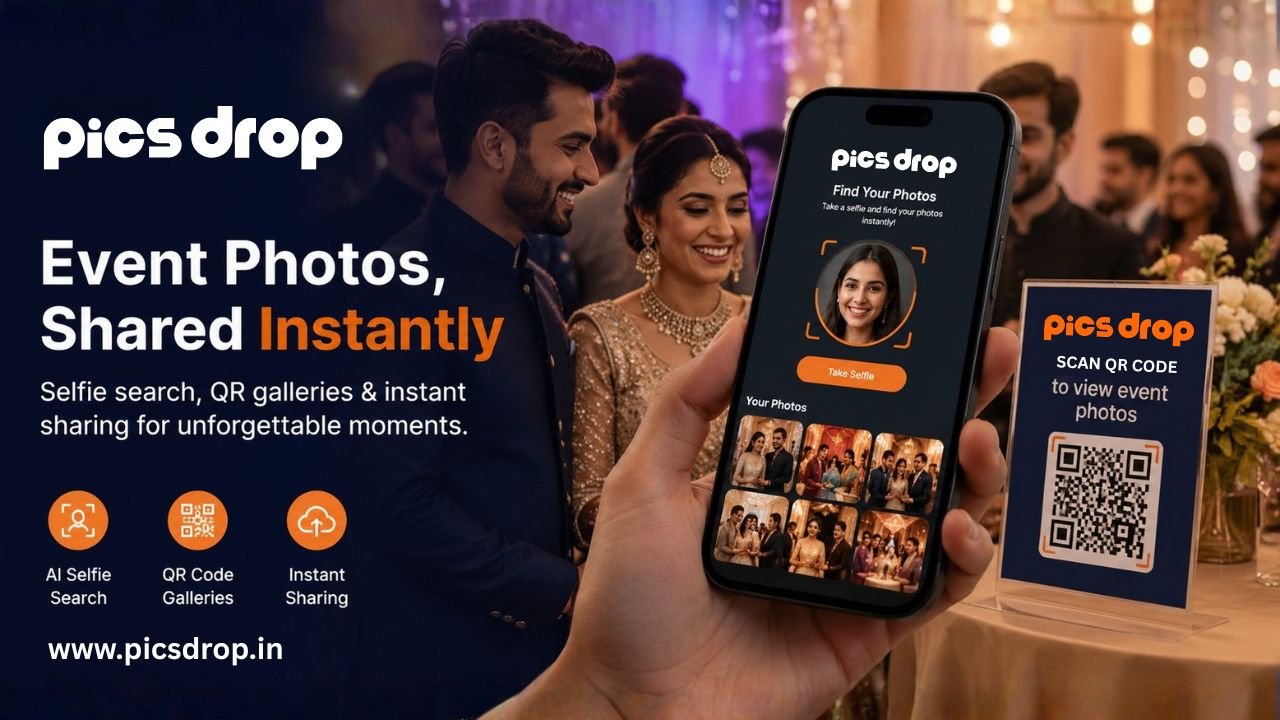
Guests scan a QR code, take a selfie, and find their photos instantly via AI face recognition. No app, no sorting. See how PicsDrop delivers event photos.
If you’ve ever been to a wedding, a corporate event, or even a college fest, you probably know that feeling. The event was amazing. The photographer was clicking away all evening. Everyone was laughing, dancing, doing those group photos where someone always has their eyes closed. And then you wait. Three days. A week. Sometimes two weeks, just to get your photos. And when you finally get them, it’s a 2,000-photo Google Drive link that takes forever to load, and your photos are somewhere buried in there between two strangers dancing and the caterer setting up tables.
That’s the situation PicsDrop was built to fix. Not in a “let’s build cool tech” way. In a “this is genuinely annoying and it shouldn’t work like this” way.
Here’s what actually happens behind the scenes at most events today. The photographer does their job beautifully, captures every laugh, every candid, every quiet moment that nobody else noticed. Then comes the delivery problem. The organizer gets a massive folder dumped in their inbox or Drive. Someone has to sit down, sort through it, figure out who’s who, create separate albums, send individual links, follow up on WhatsApp when people say they didn’t receive anything, and then follow up again when they say the link expired. It takes hours. Sometimes days. And guests? They either get everything, which means thousands of pictures they don’t care about, or they get nothing at all because the organizer just ran out of time and energy.
PicsDrop looked at this whole mess and asked a simple question: what if every guest could get exactly their own photos, instantly, without the organizer having to do anything extra after uploading?
The answer came from talking to hundreds of event photographers across India who were tired of using yesterday’s storage tools for today’s clients. The team behind PicsDrop, based out of Junagadh, Gujarat, understood this pain firsthand. They built something that combines two things that work really well together: a QR code that anyone can scan without downloading anything, and AI face recognition that finds every photo a person appears in, in under 500 milliseconds. The photographer uploads all the event photos to PicsDrop during the event or right after. PicsDrop generates a custom QR code for that event, complete with the photographer’s own logo inside it. The organizer prints it on table cards, puts it on a standee near the entrance, or just WhatsApps it to the group. Guests scan it with their phone camera, take a quick selfie, and the face recognition engine goes through every single photo in the gallery and pulls out exactly the ones that person is in.
That’s it. No app to download. No account to create. No scrolling through 2,000 pictures hoping to spot your own face somewhere on page 47.
For a guest, it feels like magic. You scan a code, take a selfie, and your phone shows you 60 photos of yourself from across the entire evening — including candids you had no idea were even taken. That photo where you were laughing at something across the room. The quiet moment near the decoration setup. The group shot where you were actually looking at the camera for once. All of it, delivered straight to you within seconds. For the photographer or organizer, it means they don’t spend half their week doing manual delivery work. They upload once, share one QR code, and PicsDrop handles the rest completely.
What makes this genuinely different from every other photo-sharing platform is that PicsDrop doesn’t try to give everyone everything. Most platforms dump the entire gallery on guests and call it a day, which sounds generous but is actually pretty useless when you’re one of 500 people at a corporate conference. When you open your gallery on PicsDrop, you’re not staring at a random collection of 2,000 event photos taken of strangers. You’re looking at your photos, the ones where you’re actually in the frame, organized and ready to download. That shift changes the whole experience. It’s not just convenient. It feels personal.
This is also where share event photos using face recognition stops being a technical feature and becomes something that actually matters to real people at real events. A wedding has 300 guests. A corporate conference has 500 attendees. A college cultural fest has students from four different departments. The photographer can’t possibly identify every face manually. The organizer definitely can’t. But PicsDrop’s AI engine, powered by Azure Face AI and FAISS vector indexing with 99.8% accuracy, can automatically, in milliseconds, for every single person who scans that QR code. That’s the scale that makes this feel completely different from anything that existed before.
Privacy is handled quietly and automatically, too. Even if the QR code gets shared beyond the original guest list, face recognition acts as a natural filter. Your photos stay yours. Someone else scanning the same code takes their own selfie and gets their own photos. Nobody sees anyone else’s pictures. Photographers can add another layer with custom passcodes, OTP access, and watermarks on preview images. For events with children, or where guests are conscious about their photos being seen by strangers, this matters a lot. The organizer doesn’t have to set up complicated access controls or password-protect different folders for different people. It just works the right way by default.
There’s a version of this story that plays out at every Indian wedding or school annual day. Someone’s naani, who has never used Google Drive in her life and definitely doesn’t have Dropbox installed, needs her photos from the function. She was there for four hours. She was in probably 80 photos. Under the old system she’d have to describe herself to the organizer, who would then have to manually scroll through hundreds of pictures, guess which ones she’s in, and somehow send them one by one on WhatsApp. Or, more likely, she just wouldn’t get them at all, and months later someone would remember and feel bad about it. With PicsDrop she scans a QR code that someone helped her with, takes a selfie, and those 80 photos from across the entire evening appear on her phone. No tech knowledge needed. No waiting. No back and forth.
For photographers, this changes something important about how clients perceive their work. Everyone talks about the shoot, the editing, the final delivery. But the actual experience of receiving photos, how it felt, how long it took, how easy it was, that experience shapes how the client remembers the photographer far more than most photographers realize. A photographer who delivers 2,000 photos to a WhatsApp group gets a “thanks!” A photographer who uses AI photo sharing so every guest individually gets their own photos delivered to their phone within hours of the event, that photographer gets calls for the next three weddings. The work is the same. The impression is completely different.
PicsDrop also goes beyond just photo delivery. It was built as a complete business tool for photographers. The same platform that handles best event photo sharing with QR code also lets photographers build a portfolio website with a custom domain, generate professional invoices with payment tracking, manage client bookings date-wise, and capture leads directly from gallery downloads. Over 600 photography businesses and studios across India are already running their entire post-event workflow through PicsDrop. More than 8,000 events delivered. More than 7 million photos shared. These aren’t just numbers — each one is a guest who got their photos before they drove home from the event.
This is also why PicsDrop has grown almost entirely through word of mouth. Photographers who use it for one event find that their clients talk about the photo delivery more than they expected. Guests mention it to friends planning their own events. Event organizers book the same photographer again partly because the post-event experience was so smooth and professional. In the photography and events industry, the product is obviously the photos the light, the composition, the moments captured. But delivery is the last impression, and in any business, last impressions are the ones that actually get remembered.
The goal going forward is straightforward. Faster face matching for even larger events. Smarter WhatsApp delivery workflows. More photographers discovering that delivery is just as important as the shoot itself. And making the gap between “event happens” and “guests have their photos” so small that waiting days for your pictures feels as outdated as waiting to get film developed.
Because photos from an event mean the most in the first 24 hours. That’s when you still remember exactly how you felt in that moment. That’s when you actually want to share them. That’s when they’re not just files sitting in a folder somewhere, they’re actual memories with weight to them.
PicsDrop is trying to make sure those memories reach you while they still feel that way.