Why Thinking Like a Business Owner Matters More Than Starting a Business
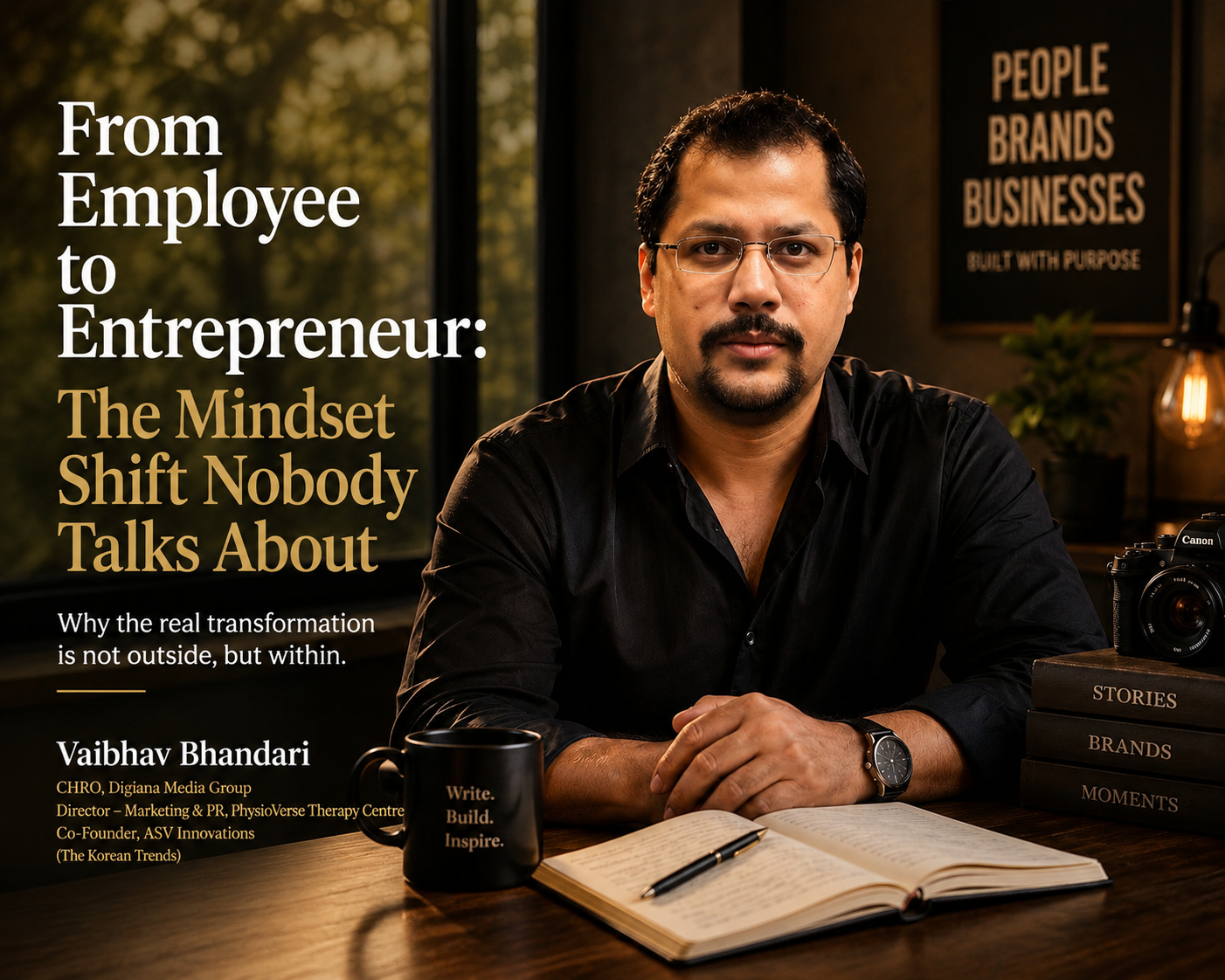
By Vaibhav Bhandari
Every year, thousands of professionals dream of leaving their corporate jobs to start their own businesses. Social media is filled with inspiring stories of startup founders who took a leap of faith and built successful companies. While these stories motivate us, they often leave out the most important part of the journey—the mindset shift required to become an entrepreneur.
The biggest challenge isn’t arranging capital, registering a company, or finding your first customer. It is changing the way you think.
Having worked across corporate leadership, human resources, branding, media, healthcare, and entrepreneurship, I have realized that many talented professionals struggle not because they lack knowledge or experience, but because they continue to think like employees while trying to build businesses.
The journey from employee to entrepreneur begins long before launching a company. It begins with changing your perspective.
Employees Execute. Entrepreneurs Create.
Corporate careers teach us to perform responsibilities efficiently. We are rewarded for meeting targets, completing assigned tasks, and delivering expected results.
Entrepreneurship demands something entirely different.
Instead of asking, “What work has been assigned to me?” entrepreneurs constantly ask:
- What problem can I solve?
- Where is the opportunity?
- How can I create value?
- What do customers really need?
Businesses are not built by people who simply complete tasks. They are built by people who identify opportunities that others fail to notice.
From Job Security to Value Creation
One of the biggest psychological adjustments is letting go of certainty.
- Employment offers predictable salaries, defined roles, structured career paths, and measurable expectations.
- Entrepreneurship replaces certainty with responsibility.
- Every decision directly impacts customers, employees, finances, and the future of the business.
The entrepreneur’s greatest security is not a monthly paycheck. It is the ability to continuously create value.
Become Comfortable with Uncertainty
There is no perfect time to start a business.
- Markets change.
- Customer preferences evolve.
- Technology advances rapidly.
Every entrepreneur eventually realizes that waiting for the “right moment” often means waiting forever.Successful entrepreneurs learn to make informed decisions despite uncertainty.Progress is always better than perfection.
Failure Is Feedback, Not the End
One of the biggest mindset shifts is changing your relationship with failure.
- Corporate environments often encourage avoiding mistakes.
- Entrepreneurship teaches you to learn from them.
- Not every idea succeeds.
- Not every marketing campaign delivers results.
- Not every investment generates returns.
The difference between successful entrepreneurs and unsuccessful ones is not the absence of failure—it is the willingness to learn, adapt, and keep moving forward.
Every setback carries a lesson if you are willing to learn from it.
Leadership Means Taking Complete Ownership
In organizations, responsibilities are divided across departments.
- Marketing has specialists.
- Finance has experts.
- Operations has managers.
- Human Resources focuses on people.
Entrepreneurs, especially during the early years, become all of these.
- They sell.
- They recruit.
- They negotiate.
- They solve customer complaints.
- They manage finances.
- They create marketing campaigns.
No work is too small when you are building something meaningful.Entrepreneurship teaches humility before it teaches success.
People Build Businesses
Many first-time entrepreneurs focus heavily on products and technology.While these are important, sustainable businesses are ultimately built by people.
- Hiring the right individuals.
- Creating a healthy work culture.
- Building trust.
- Empowering teams.
- Developing future leaders.
After years of working in Human Resources, I firmly believe that people are every organization’s biggest competitive advantage.
Businesses grow when people grow.
Personal Branding Is No Longer Optional
Today’s entrepreneurs don’t just build businesses.
- They build credibility.
- Customers buy from people they trust.
- Investors back founders they believe in.
- Employees choose leaders who inspire them.
Whether you are starting a company or leading an organization, your personal brand has become one of your most valuable business assets.
- Sharing knowledge.
- Building relationships.
- Helping others.
- Contributing meaningful ideas.
These activities create trust long before any business transaction happens.
Keep Learning, Keep Growing
- The business world is changing faster than ever.
- Artificial Intelligence is transforming industries.
- Consumer behavior continues to evolve.
- Digital marketing changes almost every year.
- The entrepreneurs who succeed are not necessarily the smartest.
- They are the ones who never stop learning.
- Books, mentors, conversations, failures, and experiences all become classrooms for an entrepreneur.
Learning is no longer an occasional activity—it becomes a daily habit.
Final Thoughts
Not everyone needs to become an entrepreneur.
Great organizations are built by exceptional professionals as much as by visionary founders.
However, every professional can benefit from adopting an entrepreneurial mindset.
- Take ownership.
- Solve problems.
- Think beyond your job description.
- Continue learning.
- Create value before expecting rewards.
Whether you remain an employee, lead a team, or build your own business, success ultimately depends on one question:
Are you creating value that others cannot easily replace?
The transition from employee to entrepreneur doesn’t begin when you register a company.
It begins the moment you stop asking, “What is my responsibility?” and start asking, “How can I create greater value?”That is the mindset shift nobody talks about.
About the Author
Vaibhav Bhandari is the CHRO at Digiana Media Group, Director – Marketing & PR at PhysioVerse Therapy Centre, and Co-Founder of ASV Innovations, the parent company behind The Korean Trends. With experience spanning human resources, entrepreneurship, branding, media, healthcare, and business strategy, he writes on leadership, organizational culture, entrepreneurship, employer branding, personal branding, and the future of work, helping individuals and organizations build stronger people, stronger brands, and stronger businesses.