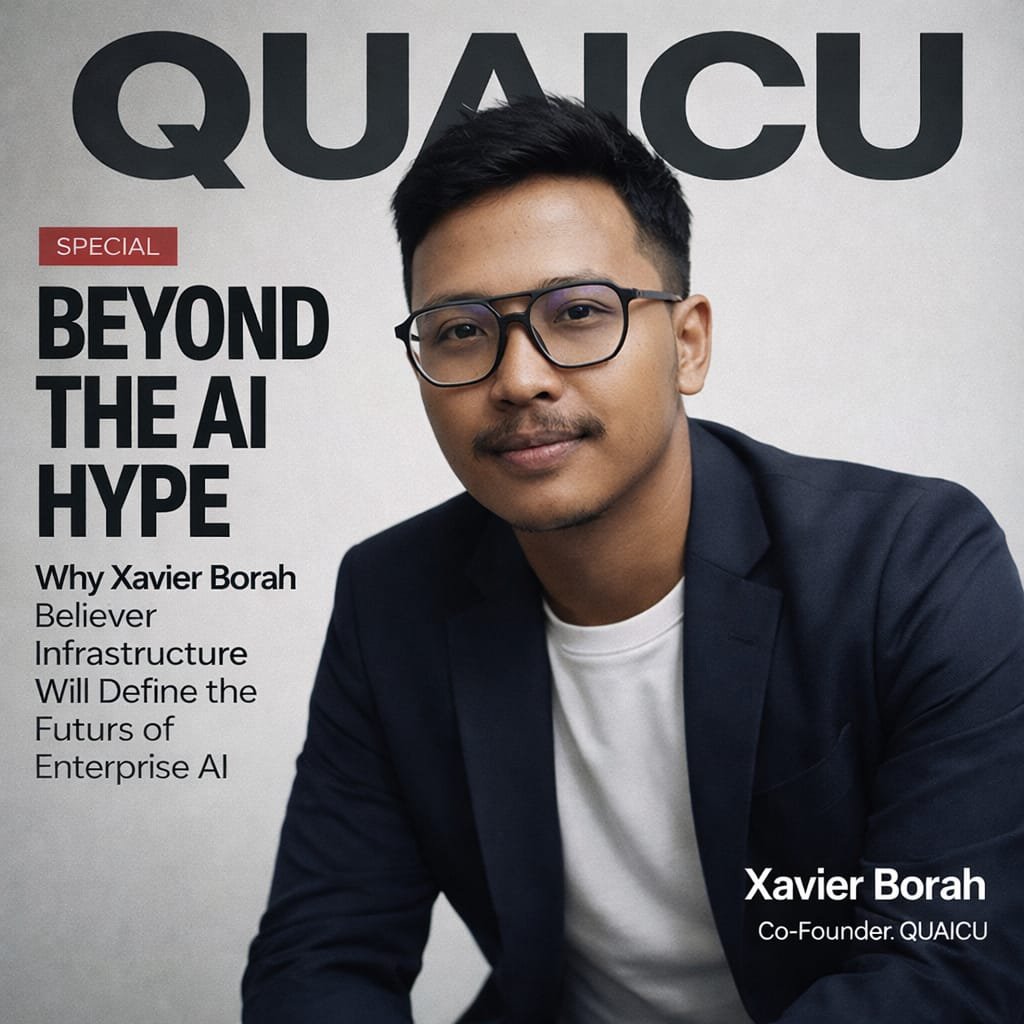
Drawing from his experience working with enterprise data ecosystems, Xavier Borah argues that the biggest barrier to AI adoption is not technology but the infrastructure institutions rely on.
Artificial intelligence has rapidly moved from research labs into boardroom strategy. Across industries, organizations are experimenting with machine learning systems, automation platforms, and generative AI tools designed to improve productivity and decision-making.
But while the pace of innovation has been remarkable, the path from AI experimentation to real-world deployment has been far less straightforward.
For Xavier Borah, this gap between AI capability and institutional reality became increasingly clear during his work with enterprise clients attempting to modernize their data environments.
The Gap Between AI Innovation and Organizational Readiness
Before co-founding QUAICU, Borah worked with organizations implementing AI-driven solutions across a variety of operational environments. His role frequently involved helping clients integrate modern data platforms and AI tools into their existing workflows.
What he encountered repeatedly was not a lack of interest in AI but a lack of readiness.
Many of the organizations he worked with had purchased advanced tools capable of analyzing data, generating insights, and automating tasks. Yet those same organizations struggled to integrate the tools into their everyday operations.
The reason, Borah found, often came down to how data was structured inside the institution.
“Most of the clients I worked with didn’t have data environments that were designed for AI,” he explains. “Their data had evolved over years across multiple systems, and that fragmentation made it difficult for AI tools to function effectively.”
Why Data Services Alone Don’t Solve the Problem
In theory, there are services designed to address these challenges. Data migration and data-streamlining initiatives can restructure datasets so that AI tools can process them more effectively.
But Borah believes these approaches often solve only part of the problem.
“These services help the AI tool read the data,” he says. “But they don’t solve the long-term usability problem.”
In many cases, once a project ends, institutions gradually fall back into the same fragmented patterns that created the problem in the first place.
The result is a cycle where organizations repeatedly invest in new technologies without fundamentally changing the operational systems those technologies depend on.
A Conversation That Sparked an Idea
Around this time, Borah began discussing these issues with Deepak Ramavath, a longtime acquaintance from college.
One conversation would eventually shape the direction of both their careers.
“Deepak once said he thought he understood why AI adoption was failing in institutions,” Borah recalls. “At first I didn’t think much of it.”
But as Borah continued speaking with clients, he began hearing similar frustrations.
Institutions were adopting modern tools that technically worked but those tools were not translating into real operational efficiency.
That realization led the two founders to explore a different approach.
From AI Tools to AI Infrastructure
Instead of building another tool within an already crowded AI ecosystem, they began thinking about what institutions might actually need: a system capable of orchestrating the many tools they already use.
The result was QUAICU, a company focused on developing what its founders describe as an institutional AI operating system.
Rather than replacing all existing software within an organization, the system is designed to integrate and coordinate fragmented tools across departments.
The concept emerged from a simple observation.
“Most solutions in the market are just tools,” Borah explains. “But institutions don’t need another tool. They need an operating system.”
Such a system would function as a coordination layer across departments connecting workflows, managing data movement, and orchestrating the many specialized applications institutions already rely on.
Implementing the Idea Through ALIS OS
In higher education, this approach is implemented through ALIS OS, QUAICU’s platform designed to unify workflows across departments such as admissions, academics, administration, and finance.
Instead of requiring universities to remove existing software, ALIS can connect with those systems, gradually integrating them into a unified operational environment.
This allows institutions to modernize their operations without discarding tools that may still serve specific functions.
Rethinking AI Infrastructure
Another key design decision involved infrastructure.
Many modern AI systems rely heavily on cloud platforms where institutional data is processed externally. But Borah and Ramavath believed regulated institutions might require a different architecture.
“Cloud platforms can be powerful,” Borah says. “But they also create dependencies that institutions don’t always control.”
For organizations operating under strict regulatory environments such as universities, hospitals, and financial institutions data sovereignty and governance are becoming increasingly important considerations.
India’s Digital Personal Data Protection (DPDP) Act, for example, places significant responsibility on institutions that manage personal data, including potential penalties for violations.
Why Governance May Define the Future of AI
Borah believes these developments will gradually shift how organizations think about AI infrastructure.
“Technology companies often operate with a ‘move fast and break things’ mindset,” he says. “But for institutions, breaking things isn’t an option.”
In environments where compliance, governance, and long-term stability matter, the infrastructure supporting AI systems may become just as important as the algorithms themselves.
As artificial intelligence continues to evolve, Borah believes the industry conversation will begin moving beyond model capabilities and toward a more fundamental question.
Not just what AI can do, but whether the systems using it are ready.
“The future of AI won’t be defined only by better models,” he says. “It will be defined by the infrastructure that allows institutions to actually use them.”