At a time when India is debating whether productivity should be measured in hours worked, Gunjan Gupta is asking a different question: what kind of workplace actually helps people do their best work?
For Gunjan, the answer is not a 70-hour work week, nor unlimited flexibility. It is about creating an environment where people have clarity about their responsibilities, but also enough trust to question, experiment and learn.
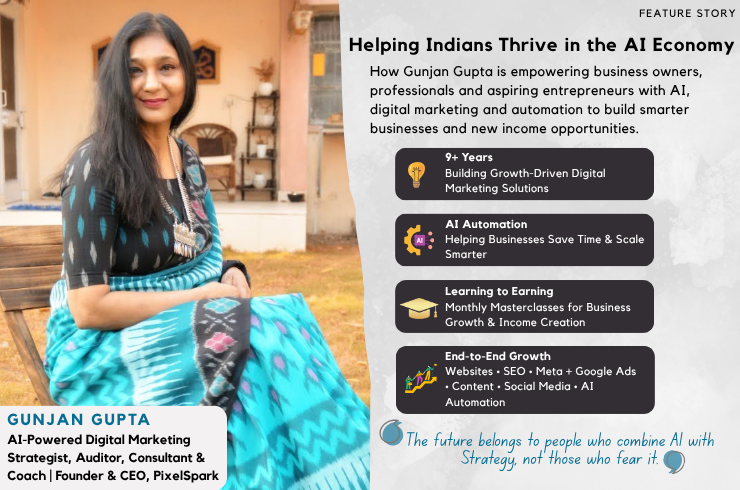
Her own journey gives that philosophy weight. After a 15-year career break as a homemaker, Gunjan returned to academics, completed her M.Tech in Computer Science, became an Assistant Professor, trained thousands of people and presented research papers internationally before moving into entrepreneurship. She eventually founded Pixel Spark, a full-service digital marketing company.
The business has since generated more than 5,000 leads and over ₹3 crore in revenue, working with businesses across sectors on digital marketing, growth and technology.
But Gunjan’s approach to building Pixel Spark goes beyond the numbers.
She has created a company where formal responsibilities are clear, but people are not expected to operate only through hierarchy. Knowledge moves through conversations, collaboration and shared experience. Employees can question ideas, contribute beyond their defined roles and learn from one another.
“An organisation is not only what is written in its policies,” Gunjan says. “It is also what people actually do when nobody is watching.”
For Gunjan, this informal layer is what gives a company its character. It is also why she places considerable importance on creating a workplace where people can disagree without fear.
A safe culture, in her view, is not one without conflict. It is one where people can raise concerns, challenge decisions and make mistakes without feeling that every mistake will be punished.
This flexibility has become particularly important in a business like Pixel Spark, where the external environment changes constantly.
Digital platforms evolve, customer behaviour shifts and new technologies appear faster than traditional processes can keep up. She therefore prefers a structure that gives people direction without making the company rigid.
That philosophy is perhaps most visible in the way Pixel Spark approaches AI.
Gunjan does not see AI simply as a productivity tool. Her bigger question is not simply what AI can automate, but which tasks should be handed over to AI and which should be redesigned around human-AI collaboration.
Some tasks can be automated. Others are better handled by humans working alongside AI. But Gunjan is cautious about allowing technology to take over the thinking itself.
“How do we delegate the processing of information to AI without surrendering judgment and human reasoning? AI should make people better at their work, not make them stop understanding their work,” she says.
At Pixel Spark, this means AI can accelerate research, generate possibilities, identify patterns and reduce repetitive work, while human judgement remains central to deciding what is actually useful. The objective is not to remove the human from the process, but to change where the human spends their time and attention.
There is another risk Gunjan believes businesses need to take seriously: AI can make an organisation more stable while making it less dynamic.
AI is heavily influenced by existing data, patterns and assumptions. If a company continually feeds its past decisions into its systems, it can become exceptionally good at reproducing what has already worked.
For a marketing company, that can be dangerous.
A campaign performed well last year. The data says certain messaging worked. The AI recommends variations of it. The team keeps optimising. Gradually, the organisation becomes extremely efficient at repeating yesterday’s logic, even when the market has moved on.
Gunjan believes this is where human judgement becomes indispensable. AI can identify patterns, but people must still ask whether those patterns remain relevant in all the dynamism. They have to challenge the assumptions behind the data rather than simply optimise them.
The same concern applies to expertise.
Not everything an employee knows can be converted into a prompt or a process document. Some knowledge develops through experience, intuition, conversations and mistakes. This implicit knowledge can be difficult to articulate, but it is often precisely what helps an organisation make better decisions.
For Gunjan, therefore, adopting AI responsibly is not about choosing between humans and technology. It is about designing the relationship between them, to extend human cognitive reach without eroding human authority.
That thinking reflects her own career. She did not build her professional life through a straight line. She stepped away, returned to education, became a teacher, moved into entrepreneurship and built a company from the ground up.
Her experience has made her deeply conscious that growth requires people and organisations to keep learning.
Today, through Pixel Spark and her Learning to Earning Masterclasses, Gunjan is taking that belief beyond her own company. She wants professionals, entrepreneurs and business owners to understand not just how to use AI, but how to use it without surrendering their judgement, expertise or ability to adapt.
For learners who are still unsure where to begin, she also shares practical suggestions, tools and insights for free through her handle @gunjanplaybook on Instagram and Gunjan Gupta on LinkedIn, helping people take their first step without having to buy a course to know where to start.
For her, the real advantage in the AI economy will not belong to the people who automate the most, but to those who know what to automate, what to question, what to learn where human judgement still matters most.
To quote Gunjan, “The smarter the machine, the more important the human becomes.”