Jaipur: When asked what inspired him to build a healthcare startup during his first year of engineering, Abhishek Narayan doesn’t begin by talking about Artificial Intelligence. Instead, he talks about something much simpler: patient medical history.
According to Abhisehk, one of the biggest challenges in healthcare is that a patient’s medical records often become scattered across different hospitals and clinics. As a result, doctors frequently do not have access to a patient’s complete medical history, making continuity of care more difficult.
This observation led the first-year Computer Science & Engineering student at Malaviya National Institute of Technology (MNIT) Jaipur to establish DocSays, a healthcare technology startup developing an AI Medical Scribe, a dedicated AI Voice Device, and a long-term Preventive Healthcare AI platform.
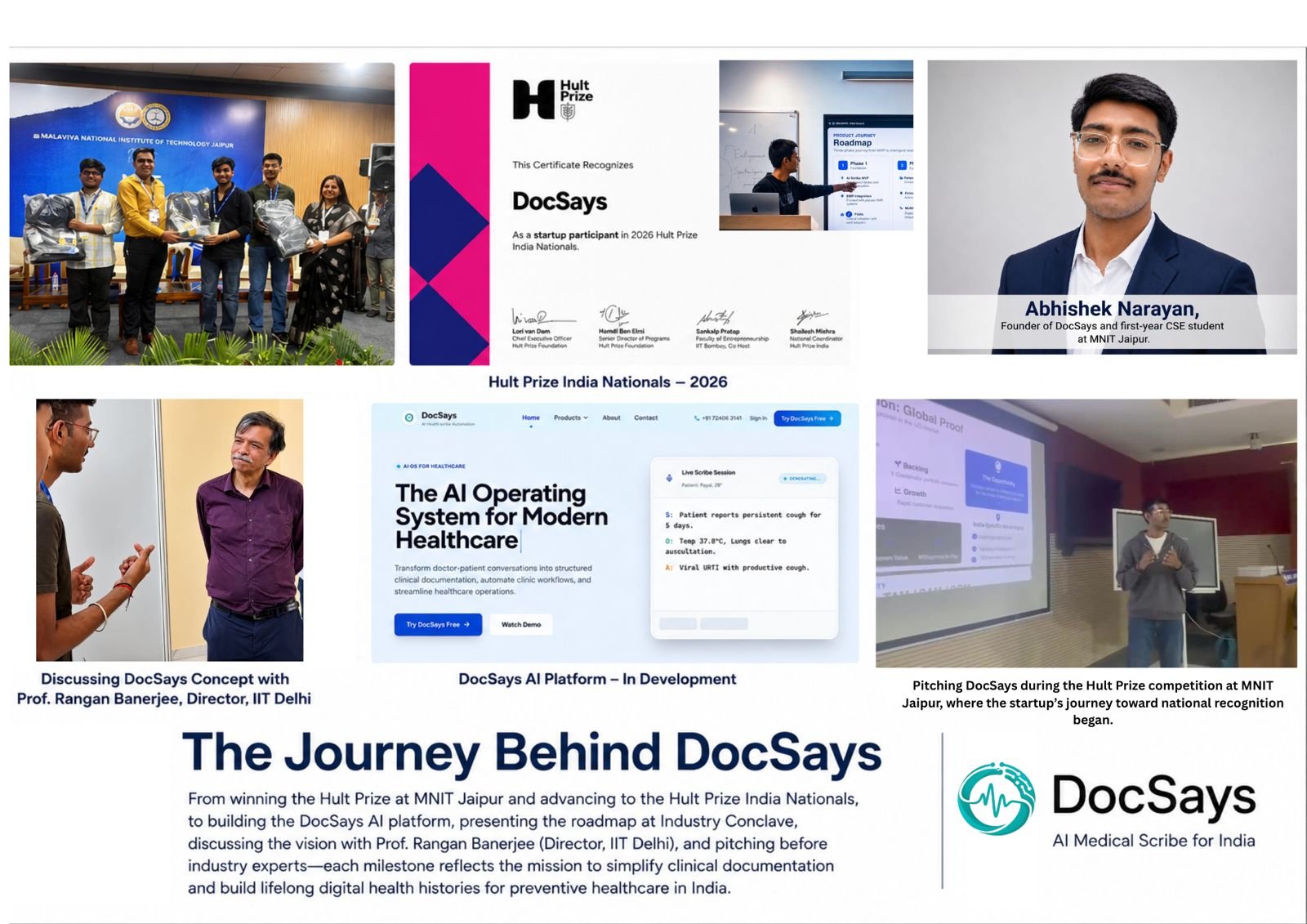
Although still in its early development stages, DocSays has already achieved significant competitive validation. The startup secured first place in the Hult Prize On-Campus Round at MNIT Jaipur, advancing as one of only two startups from Rajasthan to qualify for the Hult Prize National Round. It ultimately ranked among the Top 8.3% of more than 18,000 participating teams worldwide. The startup was also showcased among the leading startups at Industry Conclave 2026, where Narayan presented DocSays before investors, healthcare professionals, startup founders, ministers, government officials, and academic leaders.
A Healthcare Challenge Beyond Documentation
Every day, millions of doctor-patient consultations take place across India. During these consultations, doctors generate valuable clinical information, including diagnoses, prescriptions, allergies, investigations, treatment plans, and followup instructions.
However, the documentation process often continues after the consultation has ended.
In many hospitals, doctors prepare consultation notes that are later entered into hospital systems by data-entry operators. According to healthcare professionals who interacted with DocSays during Industry Conclave 2026, this workflow consumes additional manpower, increases administrative effort, and may delay the availability of structured digital records.
They also noted that many smaller hospitals and clinics operate with limited administrative resources. Maintaining dedicated data-entry staff is not always feasible, making complete digital documentation difficult to sustain consistently.
As patients visit different healthcare providers throughout their lives, their medical history often becomes fragmented across multiple systems, requiring patients to repeatedly explain previous illnesses, medications, and treatments during every new consultation.
Narayan believes solving this challenge is fundamental to improving healthcare in India.
Building Technology Around Existing Hospital Workflows
Rather than expecting doctors to change the way they work, DocSays is being designed to integrate with existing clinical workflows.
The company’s dedicated AI Voice Device is intended to remain inside consultation rooms instead of relying on doctors’ personal smartphones or laptops. According to Narayan, this approach makes adoption more practical for both government and large private hospitals, where dedicated clinical hardware fits more naturally within hospital environments.
During consultations, the system captures doctor-patient conversations and converts them into structured clinical notes, prescriptions, and consultation summaries using Artificial Intelligence.
Doctors remain responsible for reviewing and approving every generated record before it becomes part of the patient’s official medical documentation.
Following approval, the documentation can integrate with hospital EMR systems and, where supported, contribute to the patient’s Ayushman Bharat Health Account (ABHA) within India’s digital healthcare ecosystem.
The objective, Abhishek says, is to reduce repetitive documentation, improve record quality, and allow healthcare professionals to spend more time with patients instead of paperwork.
Recognition from Healthcare Leaders
At Industry Conclave 2026, Narayan presented DocSays before healthcare professionals, startup mentors, investors, government representatives, and academic leaders.
Among those who interacted with the startup was Prof. Rangan Banerjee, Director of IIT Delhi, who appreciated the initiative after hearing the concept and encouraged the team to continue developing the platform.
Healthcare professionals attending the conclave also shared practical insights based on their own clinical experience.
Several doctors pointed out that maintaining complete patient histories remains a persistent operational challenge. They explained that government hospitals often rely on manual data-entry operators to upload consultation records into digital systems, while many smaller clinics lack dedicated documentation staff altogether.
Some healthcare professionals also noted that reducing manual documentation could improve operational efficiency, lower administrative workload, and allow doctors to dedicate more time to patient care. These discussions reinforced the relevance of the problem DocSays is attempting to solve.
Looking Beyond Documentation
During the interaction, Narayan repeatedly returned to one central idea: the AI Medical Scribe is not the final goal it is the foundation.
“Our ultimate goal isn’t simply to automate clinical documentation. We’re building the data foundation that can support AI powered preventive healthcare in the future. If we begin creating structured digital health histories today, then five or ten years from now those records could help doctors identify health risks earlier and support better preventive care.”
According to Narayan, every consultation represents valuable medical data. When these records remain connected throughout a patient’s lifetime, they can provide doctors with richer clinical context while enabling future AI systems to recognize long term health trends.
He believes this approach could eventually help shift healthcare from treating diseases after they appear to identifying risks earlier through preventive care potentially improving patient outcomes and reducing avoidable healthcare costs.
Supporting India’s Digital Health Mission
Narayan says DocSays is being developed with the objective of supporting the Government of India’s Ayushman Bharat Digital Mission (ABDM) and ABHA ecosystem.
His long-term ambition is to work toward deploying the DocSays AI Voice Device across government hospitals in Rajasthan before expanding to healthcare institutions in other parts of the country.
According to him, as India’s healthcare system continues adopting digital infrastructure, solutions that simplify clinical documentation while generating structured patient records could play an important role in supporting this transformation.
Looking Ahead
DocSays is currently refining its AI platform, advancing development of the AI Voice Device, expanding multilingual capabilities, and preparing pilot collaborations with healthcare providers.
The company plans to work closely with hospitals, doctors, healthcare institutions, and government stakeholders to validate the technology in real clinical environments before wider deployment.
For Abhishek, however, the long term objective extends beyond software or hardware.
He hopes that one day, every consultation in India will contribute to a secure lifelong digital health history creating the foundation for the next generation of AI-assisted preventive healthcare.
About DocSays
DocSays is a healthcare technology startup founded by Abhishek Narayan , a B.Tech Computer Science & Engineering student at Malaviya National Institute of Technology Jaipur.
The startup is developing an AI Medical Scribe, a dedicated AI Voice Device, and a Preventive Healthcare AI platform to simplify clinical documentation, reduce doctors’ administrative workload, and support structured lifelong digital health histories within India’s evolving digital healthcare ecosystem.
Website: www.docsays.in
Abhishek
Founder, DocSays
Website: www.docsays.in
LinkedIn: https://www.linkedin.com/in/abhisheknarayanhathwala/