
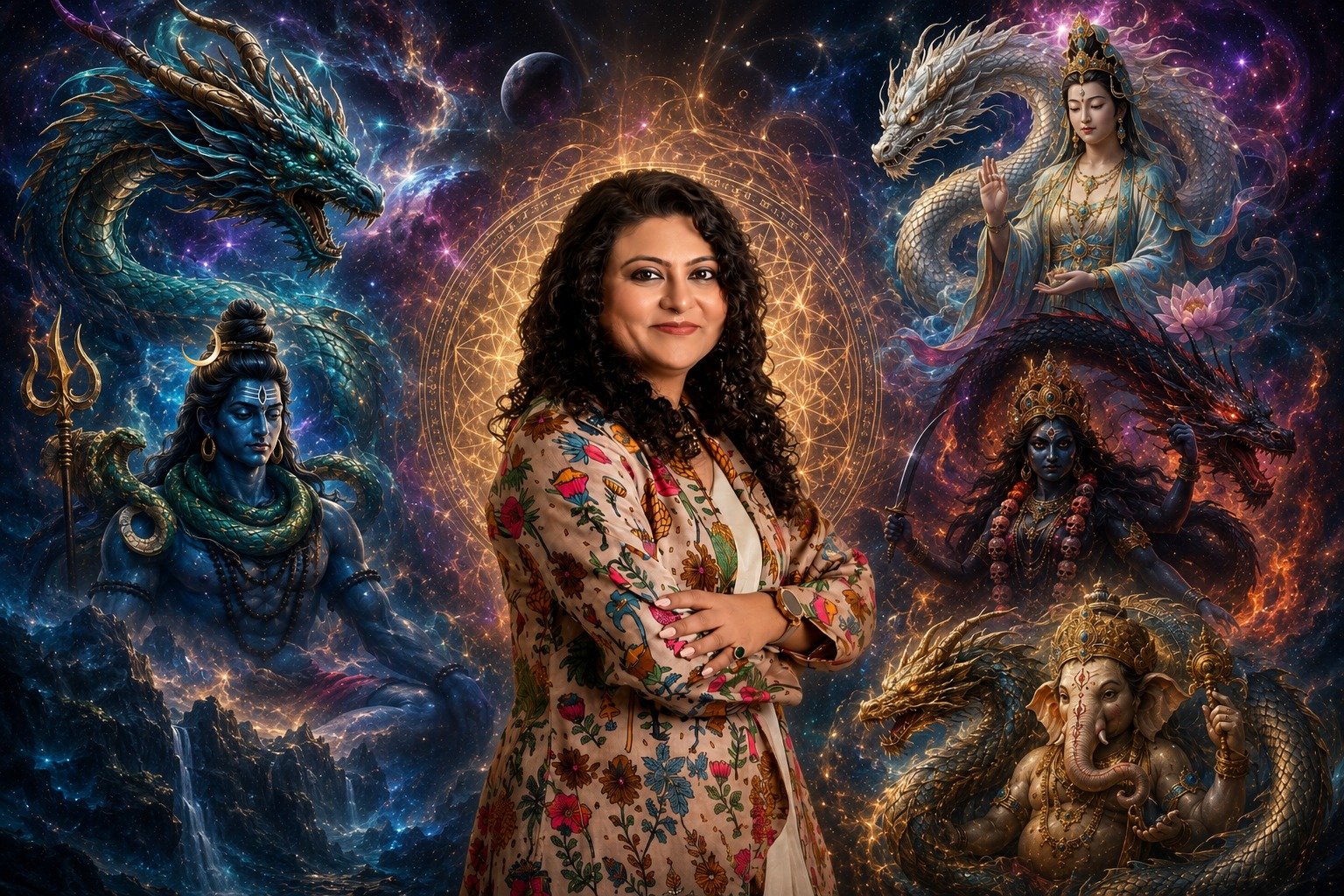
By Siddhi Shah
When the word dragon is mentioned, most people immediately imagine gigantic winged creatures breathing fire over medieval castles. Yet, long before dragons became fantasy icons, Eastern civilizations were already honouring them as symbols of wisdom, protection, divine authority and spiritual evolution.
Across India, Tibet, China and Southeast Asia, dragons have rarely been viewed as monsters. Instead, they have been revered as celestial beings—guardians of sacred knowledge and companions of enlightened masters.
One of the oldest and most fascinating examples is Vasuki, the Serpent King of Hindu tradition.
Known for resting around the neck of Lord Shiva, Vasuki is not merely a symbolic serpent. He represents awakened life force, divine protection and the mastery of Kundalini energy. During the legendary Samudra Manthan (Churning of the Cosmic Ocean), Vasuki willingly became the cosmic rope used by the Devas and Asuras to churn the nectar of immortality—a role that symbolizes service, sacrifice and transformation.
Interestingly, this symbolism extends well beyond India.
In Tibetan Buddhism, the great serpent kings are celebrated as Dragon Kings. In Thailand, Lord Shiva—known as Phra Isua—is often depicted riding a magnificent Dragon rather than simply wearing Vasuki around his neck. While artistic interpretations vary across cultures, the underlying message remains remarkably consistent: the sacred serpent and the celestial dragon represent the same enlightened force expressed through different cultural lenses.
Chinese traditions further expand this understanding through the concept of Celestial Dragons, benevolent beings associated with prosperity, divine order, rainfall, wisdom and protection. Unlike their Western counterparts, these dragons are not feared—they are honoured.
More Than One Dragon Clan
Ancient spiritual traditions and modern esoteric teachings suggest that the Serpentine Dragon lineage is not singular. Instead, it comprises multiple dragon clans, each resonating with different divine qualities and spiritual purposes.
Among the most revered are the Celestial Dragons, who are believed to work alongside higher divine beings, assisting humanity during periods of transformation and spiritual growth.
Each Dragon Clan carries a distinct energetic signature.
The Dragons of Lord Ganesha are associated with removing obstacles, opening opportunities and supporting both spiritual evolution and material success. Their energy is often described as practical, intelligent and exceptionally swift.
The Dragons of Maa Kali embody fierce protection. They are believed to dissolve fear, illusion and emotional drama while creating energetic boundaries against lower vibrations.
The Dragons of Lord Shiva are regarded as profound healers and keepers of mystical wisdom. Their guidance is linked with manifestation, higher consciousness, purification and inner awakening.
The Dragons of Goddess Guan Yin resonate with compassion, forgiveness and karmic healing. Their presence is believed to help individuals release emotional burdens and create greater harmony within their spiritual journey.
Regardless of their lineage, these dragons are often described as guardians of ancient wisdom, light codes, sacred knowledge and higher frequencies of consciousness.
A Personal Journey with Dragon Consciousness
My own relationship with Dragon consciousness began over five years ago.
Since then, I have worked with different Dragon energies for healing, meditation and spiritual guidance. Their presence has supported me through many areas of life—from strengthening relationships and emotional resilience to improving confidence, prosperity and spiritual clarity.
In my experience, dragons enter a person’s life for different reasons. Sometimes they appear because an individual naturally resonates with the deity they accompany. At other times, consistent spiritual practice gradually aligns one’s energy with what I describe as a Dragon DNA—a state where a seeker begins resonating with the wisdom, courage and consciousness of a particular Dragon Clan.
Rather than dramatic supernatural experiences, this connection often unfolds quietly through intuition, synchronicities and inner transformation.
Beginning Your Own Connection
Connecting with Dragon energies need not be elaborate.
A simple practice begins by lighting sandalwood or frankincense incense, sitting quietly and mentally inviting a Dragon Clan that resonates with your intention. Rather than expecting immediate visions, simply observe your thoughts, feelings or intuitive impressions.
Sometimes guidance arrives during meditation.
Sometimes it appears hours later through an unexpected solution, a dream or an inner knowing.
And sometimes nothing happens immediately—which is equally valid. Spiritual relationships often develop gradually, built on sincerity rather than expectation.
Because Dragon energies are traditionally regarded as warm and highly activating, practitioners commonly recommend remaining well hydrated and grounding oneself before and after meditation through deep breathing, walking barefoot on natural ground or spending a few quiet moments in nature.
About the Author
I am Siddhi Shah, a Spiritual Energy Activation Coach, Dragon Channel and TEDx Speaker. Over the past five years, I have worked with Dragon consciousness through healing sessions, intuitive guidance and spiritual teachings, supporting more than 11,000 individuals worldwide.
I am also the founder of the Celestial Dragons Healing System, a spiritual framework designed to help seekers consciously work with Guardian Dragons and higher Dragon realms through meditation, healing and energetic practices.
For readers interested in exploring Dragon meditations and introductory practices, additional resources are available through my YouTube channel, Yana’s Healing Studio.
Whether viewed through mythology, symbolism or spiritual practice, the enduring presence of dragons across civilizations raises an intriguing possibility: perhaps these ancient guardians have never truly disappeared. Perhaps they have simply been waiting for humanity to remember them—not as creatures of fantasy, but as timeless symbols of wisdom, courage and transformation.