
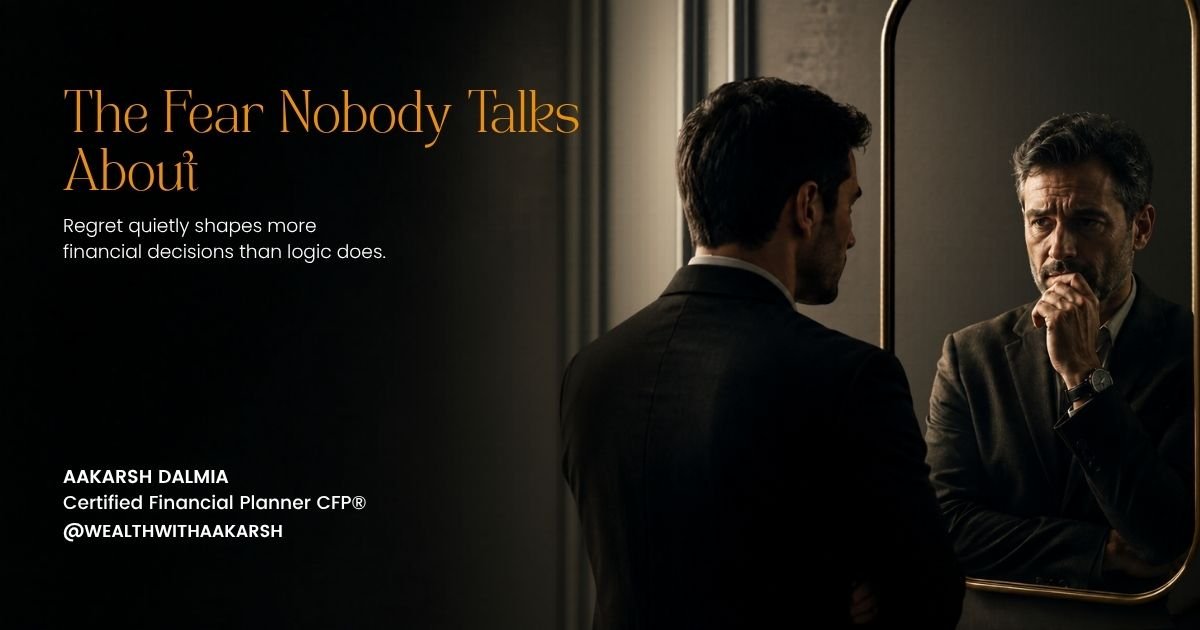
The Fear Nobody Talks About in Personal Finance
You think you’re making a financial decision. You’re actually making an emotional one.
By Aakarsh Dalmia, CFP · Author, Live Rich Die Rich · @wealthwithaakarsh
Regret aversion is when you make — or avoid — a financial decision not based on what’s actually best for you, but based on how bad you’d feel if it went wrong.
It isn’t the fear of losing money. It’s subtler, quieter, and far more expensive than that. It’s the fear of regret itself — the fear of one day looking back and feeling like you made the wrong call.
In seven years of managing wealth for over 300 Indian families, I’ve watched this one invisible bias quietly drain more wealth than bad markets, wrong funds, or poor timing combined. And almost nobody recognises it while it’s happening — because it doesn’t feel like fear. It feels like being careful.
Loss Aversion vs Regret Aversion
Most people have heard of loss aversion — the well-documented tendency to feel the pain of a loss more strongly than the pleasure of an equivalent gain. But regret aversion is something different, and the distinction matters enormously in practice.
Loss aversion says: “I don’t want to lose money.”
Regret aversion says: “I don’t want to feel stupid for having made a bad decision.”
They sound similar, but they drive completely different behaviour. Loss aversion keeps you out of risky assets. Regret aversion keeps you out of any decision where you could later be blamed — including by yourself. It isn’t about the outcome. It’s about the story you’d have to tell yourself afterward.
How It Shows Up in Real Financial Life
Regret aversion is everywhere in personal finance once you know what you’re looking for.
Holding a bad investment far too long
Selling locks in the loss and makes it real. As long as you hold, you can tell yourself it might recover. The regret of having bought wrong is avoided by never officially admitting the decision was wrong. The investment stays in the portfolio long after any rational reason to hold it.
Never investing at a market high
The fear isn’t really about losing money — it’s about the specific image of having invested at the peak and watching it fall. That image feels so painful that people wait, and wait, and wait. The market goes higher. They still don’t invest. The regret of missing the rally now compounds on top of the original fear.
Sticking with whatever everyone else is doing
If you invest in a popular fund and it underperforms, the regret is softer — everyone else suffered too. If you invest in something unconventional and it underperforms, the regret is acute — you deviated and it cost you. So people herd. Not because herding is rational, but because it distributes the emotional blame.
Staying in a bad insurance policy
You’ve paid premiums for eight years into a ULIP you know is underperforming. Surrendering means admitting the original decision was wrong. So you keep paying. Every year is another year of throwing good money after bad — but the regret of having started is more painful than the ongoing cost of continuing.
Not leaving a job or business that isn’t working
Leaving means confirming the original choice was a mistake. Staying keeps the story open. Regret aversion doesn’t just affect your portfolio — it affects every financial decision that requires admitting you were wrong about something.
“You think you’re making a financial decision. You’re actually making an emotional one.”
Why It’s More Dangerous Than Most Biases
Most cognitive biases distort your perception of facts. Regret aversion distorts your perception of what you’re actually deciding.
The truly dangerous version is what researchers call anticipated regret — you don’t regret something that already happened. You imagine a future version of yourself regretting a decision you haven’t made yet, and that imagined feeling drives you away from the decision entirely. It’s a ghost of a feeling about something that hasn’t happened yet, running your actual financial life in the present.
Consider the client who told me last year that the market “felt too high” to invest. He said he’d invest when it corrected. The market went up another 18%. He still hasn’t invested. He isn’t afraid of losing money anymore — he’s afraid of the specific feeling of having finally invested and watching it fall. That feeling — not data, not analysis — is what’s keeping him out.
The Antidote — Reframe the Question
The only clean way out is to shift the frame of the decision entirely. Regret aversion only ever accounts for the downside of acting. It almost never accounts for the cost of not acting.
Instead of asking: “How will I feel if this goes wrong?”
Ask: “What is the cost of not deciding?”
When you force yourself to calculate what inaction actually costs — the returns not earned, the insurance not bought, the SIP not started three years ago — the emotional calculus changes. Suddenly the regret of not acting becomes as visible as the regret of acting.
The clients who kept their SIPs running through the COVID crash didn’t do it because they were fearless. They did it because they had been helped to see that stopping carried a cost too. That is the entire job of a good financial advisor — not picking the best fund, but making sure both sides of the emotional equation are visible when a client is making a decision under pressure.
Next time you find yourself avoiding a financial decision, ask yourself honestly — am I avoiding this because it’s genuinely wrong, or because I don’t want to feel bad if it goes sideways? That answer will tell you more about your financial future than any market forecast ever will.
Aakarsh Dalmia is a Certified Financial Planner and the author of Live Rich Die Rich (Foreword: Nilesh Shah, MD, Kotak Mahindra AMC). He manages ₹100Cr for 300 Indian families. Follow him on Instagram: @wealthwithaakarsh
Aakarsh Dalmia
Certified Financial Planner CFPCM
@wealthwithaakarsh