For decades, deity clothing has largely been treated as a commodity. Fabrics were often chosen for cost, designs were repeated endlessly, and very little attention was given to the details that devotees themselves care deeply about.
Walk through many traditional markets and you will find Laddu Gopal dress and Kanha Ji poshak being sold almost like commodities, stacked in piles, measured by quantity rather than craftsmanship, and designed with little consideration for fabric quality, fit, durability, or aesthetics.
Yet the relationship devotees have with Laddu Gopal Ji is anything but ordinary.
For many families, dressing Kanha Ji is a daily act of seva. It is part of the morning routine, part of festival preparation, and part of expressing devotion itself. As home mandirs become more thoughtfully curated and devotees invest more care into daily shringar, expectations around deity clothing have naturally evolved.
That simple observation became the foundation of Divyambar.
A Simple Question That Sparked a Different Approach
The team behind Divyambar began with a question that rarely gets asked in the deity clothing industry:
If we carefully choose soft fabrics, thoughtful designs, and quality craftsmanship for our loved ones, shouldn’t the same care go into the poshak we offer to Bhagwan Ji?
For years, many devotees had only two choices. Either inexpensive mass-produced clothing with limited design variation, or custom-made options that were difficult to find consistently. Sizing often varied, fabrics were inconsistent, and the same embroidery patterns appeared repeatedly across sellers.
Divyambar saw an opportunity to approach deity clothing differently, not as a low-cost product category, but as a category worthy of design, craftsmanship, and attention to detail.
Bringing Fashion Design Thinking Into Deity Clothing
One of the biggest differences in Divyambar’s approach is the attention given to design.
Rather than repeating the same patterns season after season, the brand develops original concepts inspired by devotional traditions, temple shringar, festival celebrations, and the timeless aesthetics associated with Krishna bhakti.
Design development begins long before a single stitch is made. Colour combinations are explored, embroidery layouts are refined, fabrics are evaluated, and motifs are adjusted until the final design feels visually harmonious during darshan.
In a category where design innovation has traditionally been limited, this attention to detail is helping redefine expectations around Laddu Gopal dress, Radha Rani poshak, and complete Radha Krishna shringar.
Why Fabric Quality Matters
A beautiful design alone is not enough.
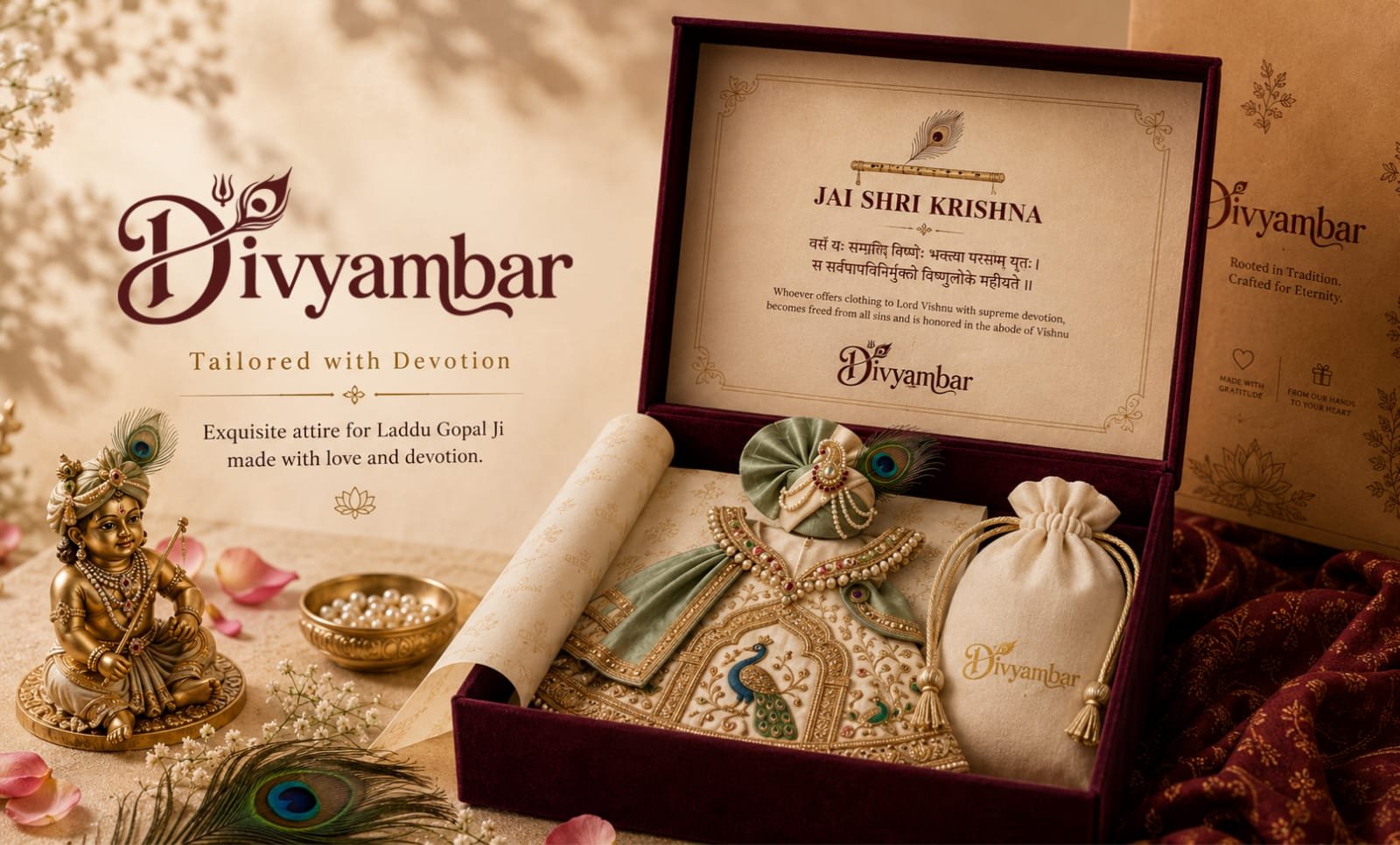
The texture of the fabric, the richness of the weave, the drape of the garment, and the overall presentation all contribute to the final experience. Whether it is a daily Laddu Gopal dress, a handcrafted Radha Krishna dress, or a festive heavy poshak, devotees increasingly look for clothing that feels as thoughtful as the devotion behind it.
This focus on quality has encouraged a growing appreciation for carefully selected fabrics, hand embroidery, and garments designed to be treasured rather than replaced.
Preserving Hand Embroidery in a Machine-Made World
As machine embroidery becomes increasingly common, traditional handwork techniques are becoming less visible across many apparel categories.
Divyambar has chosen a different path.
Many creations continue to incorporate detailed hand embroidery and artisan craftsmanship inspired by the rich devotional traditions of Vrindavan and Mathura. The process is slower, requires greater skill, and demands more patience, but it creates a level of character and individuality that mass production simply cannot replicate.
For devotees seeking handmade Kanha Ji poshak, Radha Rani poshak, and thoughtfully crafted festival attire, this distinction matters.
Beyond Poshak: Creating Complete Shringar Experiences
Modern devotees are increasingly looking beyond the dress itself.
They are searching for complete Radha Krishna shringar, coordinated Laddu Gopal mukut, jewellery sets, bansuri, singhasan styling, and beautifully arranged darbar presentations. The focus is shifting from individual products to creating meaningful devotional experiences.
Recognising this shift, Divyambar has expanded its focus beyond garments alone and continues to help devotees understand sizing, styling, seasonal dressing, and complete shringar coordination.
Readers can explore the brand’s collections and educational resources at https://www.divyambar.com and browse its Laddu Gopal dress collection at https://www.divyambar.com/collections/buy-laddu-gopal-ki-dress-collection.
Building a Brand Around Devotion, Not Just Products
At its core, Divyambar is not trying to become the largest seller of deity clothing.
It is working to elevate the way deity clothing is perceived.
By combining thoughtful design, carefully selected fabrics, artisan craftsmanship, and educational guidance, the brand is contributing to a growing movement that treats Laddu Gopal dress, Kanha Ji poshak, Radha Rani poshak, and Radha Krishna shringar with the same care and attention traditionally associated with beautifully crafted apparel.
As more devotees seek meaningful ways to express their bhakti through daily seva and festival celebrations, Divyambar continues to build trust through a simple belief:
Tailored With Devotion.