
The tribal districts of South
Gujarat—encompassing Tapi, Narmada, Surat, Bharuch, and Dang—have long struggled with a stark divide in healthcare accessibility. While nearby major cities boast state-of-the-art corporate medical centers, rural and tribal populations frequently face prohibitive costs and geographical barriers during medical emergencies. Bridging this critical gap is Dr. Pranay Chaudhari, a dedicated general surgeon and endourologist operating out of Shree Sardar Smarak Hospital in Bardoli. Recently, his life-saving surgical interventions caught the attention of thet Health Officer of Bharuch, prompting a formal letter of appreciation to recognize his team’s efforts. This official acknowledgment raises a vital question for the broader public: if regional health departments are recognizing this monumental grassroots impact, why shouldn’t the wider community?
For agricultural laborers and tribal families residing in the deep interior pockets of South Gujarat, a sudden surgical emergency often equates to crippling financial debt. The healthcare landscape is heavily skewed; a procedure that is routine in a metropolitan hub like Surat can financially ruin a rural family. This disparity highlights the absolute necessity of robust trust hospitals and dedicated surgical specialists who are willing to bring tertiary-level care to the periphery. Strategically located, Bardoli serves as a vital medical lifeline for these underserved regions, intercepting critical cases before the agonizingly long and expensive transfer to urban corporate hospitals becomes the only remaining option.
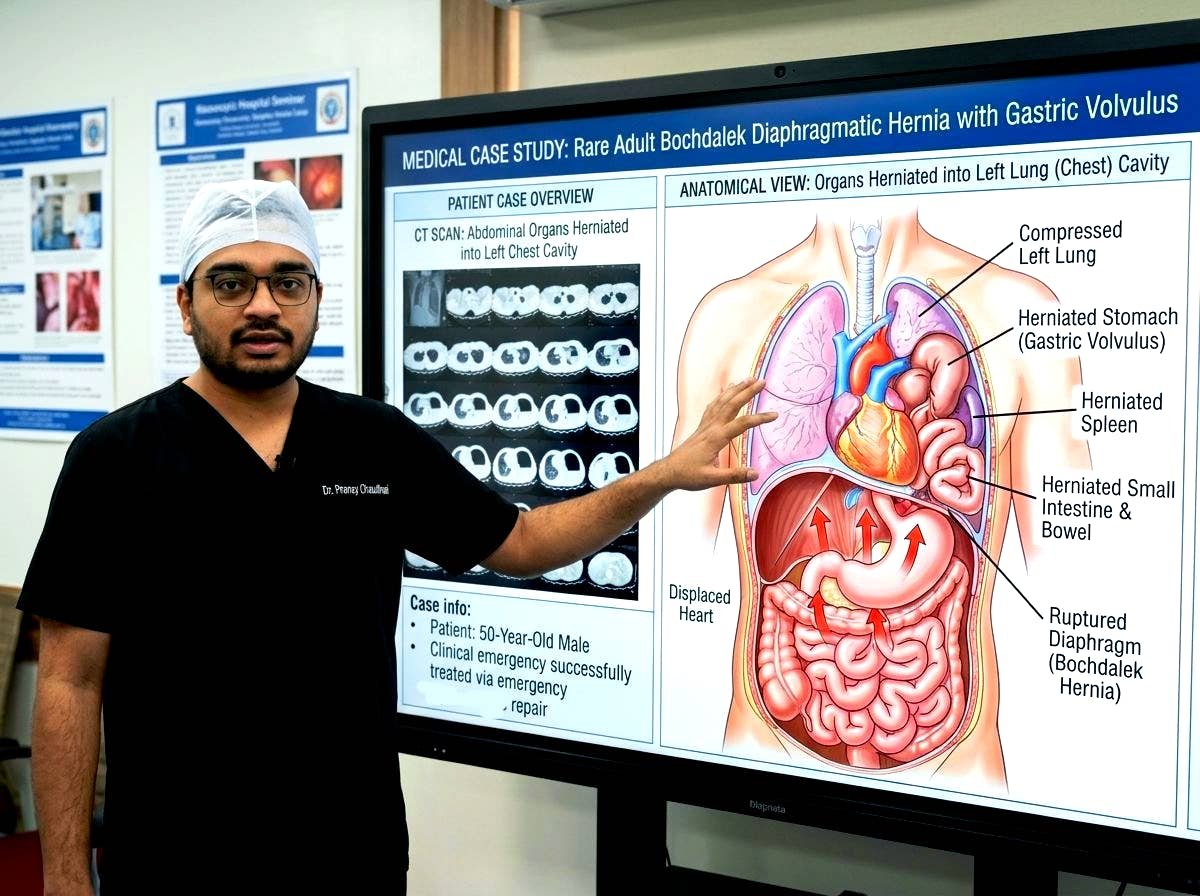
The profound difference between commercial healthcare and community-focused medicine is best illustrated by a recent, highly complex emergency case originating from Sagbara taluka in the Bharuch/Narmada district region. A patient was brought into Shree Sardar Smarak Hospital presenting with a severe, life-threatening condition: a traumatic diaphragmatic hernia. The internal anatomy had suffered catastrophic displacement. The patient’s stomach, spleen, and a significant section of the small intestine had herniated upward through a tear in the diaphragm and entered the left chest cavity. Compounding the critical nature of this respiratory and abdominal emergency, the trapped small intestine had been cut off from its blood supply and had turned gangrenous.
In a standard corporate hospital setup in an urban center like Surat, treating a case of this magnitude requires intensive care, highly specialized surgical intervention, and prolonged post-operative monitoring. The financial estimate for such a multi-organ emergency procedure typically runs between ₹6,00,000 to ₹7,00,000. For a family from a rural taluka like Sagbara, this figure is virtually an impossible hurdle. High medical costs frequently lead to tragic outcomes in tribal belts simply due to an inability to pay. However, operating within the framework of a trust-run institution, Dr. Chaudhari and his surgical team took on this high-risk case for a mere fraction of the standard cost—completing the entire life-saving surgical protocol for just ₹40,000 to ₹60,000.
The procedure itself was extensive, carrying an incredibly high mortality risk due to impending sepsis and lung compression. The operation required meticulous surgical precision to safely retract the displaced stomach and spleen out of the chest cavity and back to their proper anatomical positions in the abdomen. Because the herniated small intestine was already gangrenous, the necrotic tissue had to be surgically removed (resection) to prevent fatal systemic infection. The healthy ends of the bowel were then carefully reconnected (anastomosis) to restore normal digestive function. The ruptured diaphragm was structurally repaired to prevent any future herniation, and a left Intercostal Drain (ICD) was placed to clear the chest cavity of accumulated fluids and air, allowing the compromised left lung to fully re-expand. Despite the extreme risks associated with gangrenous bowel and acute respiratory distress, the complex surgery was a resounding success, and the patient was safely treated and discharged.
This single Sagbara case is not an isolated anomaly, but rather a reflection of a broader, sustained surgical mission. Dr. Chaudhari brings advanced surgical expertise directly to a demographic that is systematically overlooked. Over the course of his career in bardoli, he has successfully executed over 2,094 major surgeries till July ,2026, including more than 1,000 general surgeries and 700 endourological procedures, establishing a consistent track record of high-volume, high-quality care in trust-based healthcare environments. When regional government authorities issue official appreciation for such interventions, it serves as a powerful validation that the backbone of public health relies on these accessible, highly skilled institutional lifelines.
The true measure of a society’s healthcare system is not found in the luxury of its urban corporate hospitals, but in the survival and recovery of its most vulnerable patients. The surgical work being done across South Gujarat’s tribal corridors proves that high-quality, complex medical care does not have to come at a financially ruinous price. By transforming regional trust hospitals into active hubs for advanced, affordable surgical intervention, the healthcare landscape for the communities of Tapi, Narmada, Surat, Bharuch, and Dang is being fundamentally altered for the better. Recognizing and championing this crucial work is the first step in supporting a scalable model of medical practice where human life and community well-being are always prioritized over profit.