By CA Dinesh Bhattar, CEO, Bonanza Merchant Banking | Chartered Accountant | 30+ Years in Indian Capital Markets | IPO & Pre-IPO Advisor
For years, raising pre-IPO capital was largely about valuation, growth potential, and finding the right investors. In 2026, those factors still matter, but there is a new variable that has become equally important: timing.
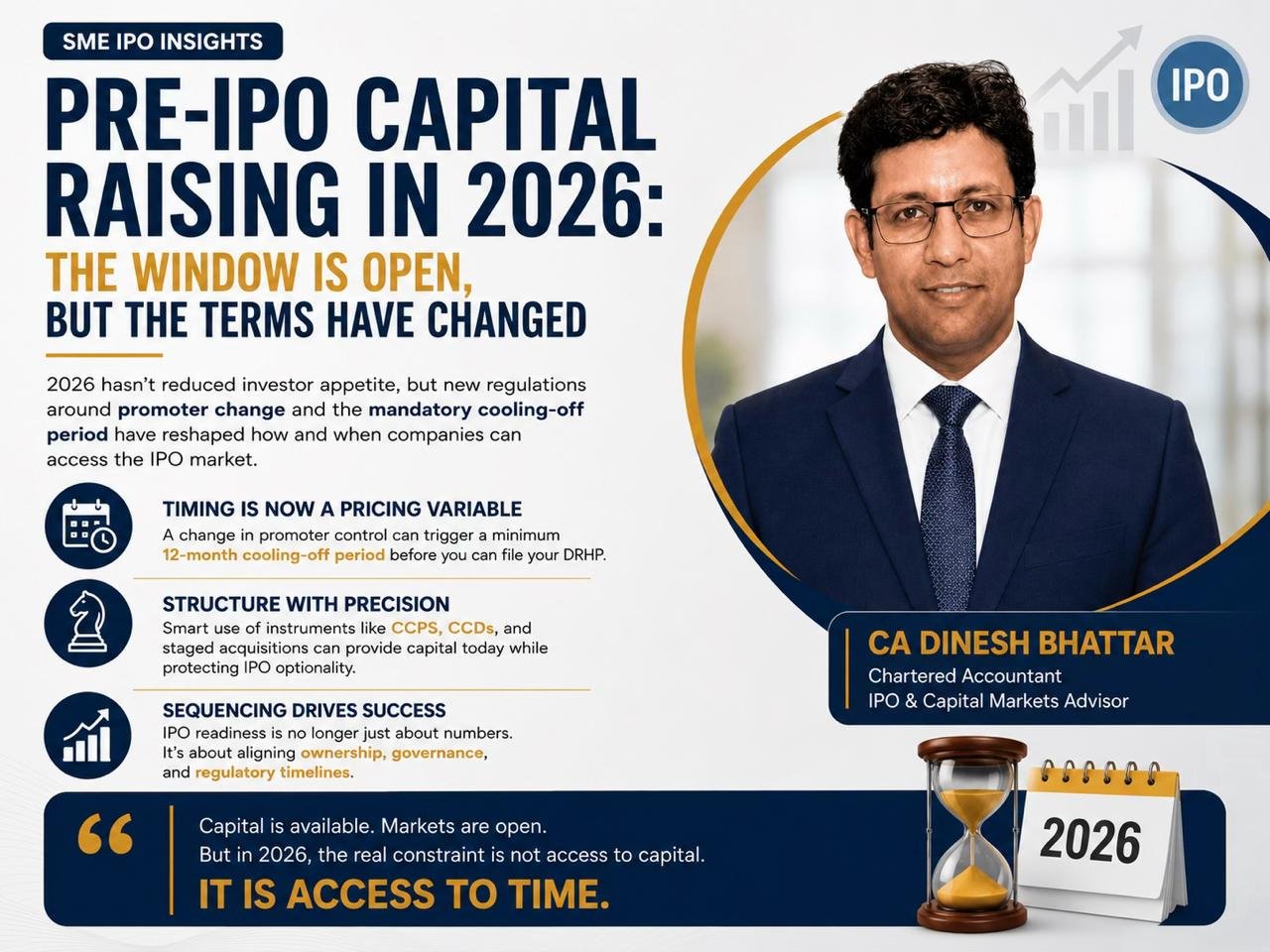
A recent regulatory shift has quietly changed how companies need to think about fundraising before an IPO. If a transaction results in a complete change in promoter control, the company may be required to wait for a cooling-off period before becoming eligible to file its DRHP. In practical terms, this means that a control transaction today could delay an IPO by more than a year.
That changes everything.
What was once a straightforward capital raise has now become a sequencing exercise. Founders, investors, and advisors must carefully plan not just who comes onto the cap table, but when and how they enter.
Consider the implications. A company that undergoes a promoter-level transaction in 2026 may need to wait twelve months before filing for an IPO. Add the normal regulatory review and execution process, and the actual listing could move out by 15 to 18 months. In a market where sentiment and valuations can change rapidly, that delay can significantly impact outcomes.
As a result, investors are becoming more cautious about timing risk. Many are demanding higher return expectations to compensate for longer holding periods and reduced liquidity visibility.
This is why capital structures have become far more sophisticated. Instead of immediate control transfers, transactions are increasingly being designed using instruments such as CCPS, CCDs, staged acquisitions, and performance-linked equity transfers. The objective is simple: provide capital today while preserving IPO flexibility tomorrow.
However, structure alone is not enough. Regulators increasingly look at the substance of a transaction rather than its form. If effective control has shifted, the clock may start regardless of how the deal is documented.
Equally important is governance readiness. Companies approaching the public markets must ensure compliance, robust internal controls, clean statutory records, transparent ESOP structures, and a board framework that can withstand investor scrutiny.
The biggest lesson for founders is clear: IPO readiness is no longer just about financial performance. It is about sequencing ownership, governance, and capital in a way that aligns with regulatory timelines.
Capital remains available. Investor appetite remains strong. The IPO market remains open.
But in 2026, success is increasingly determined by how intelligently the journey is planned.
Because the scarcest resource before an IPO is no longer capital.
It is time.
Twitter: https://x.com/cadineshbhattar