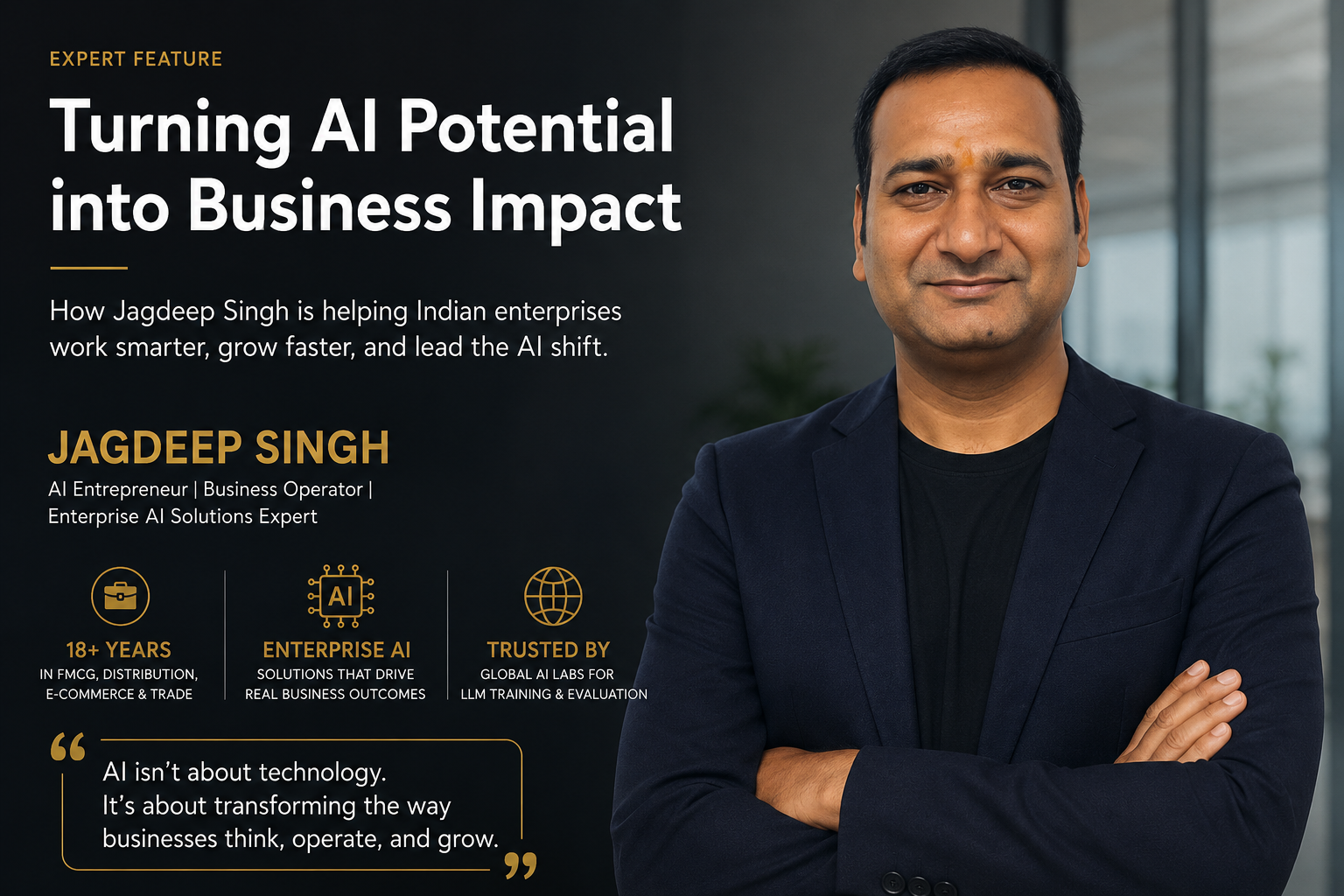
By Jagdeep Singh, Enterprise AI Solutions Expert
For nearly two decades, I lived inside the engine rooms of Indian business.
Sales targets. Distribution networks. Modern trade negotiations. Quick commerce launches. P&L reviews. I managed revenue portfolios worth hundreds of crores, led large teams across geographies, and built operating systems for businesses that needed to grow fast and stay disciplined.
I wasn’t a technologist. I was a commercial operator – someone who understood how revenue is actually built, territory by territory, distributor by distributor, decision by decision.
That background is precisely why, when AI arrived, I saw something most people missed.
The Slow Realization
Around 2023, I noticed a gap that genuinely bothered me. Every night, after a full day of running business responsibilities, I was experimenting with AI workflows – building automation systems, testing prompts, designing solutions to problems I had lived with for years. The results were striking. Processes that consumed hours were shrinking to minutes.
And yet the businesses around me were either chasing AI headlines or ignoring AI entirely.
One evening, a thought hit me with uncomfortable clarity: “If I’m this obsessed with solving real business problems using AI, why am I treating it like a side project?”
That wasn’t a dramatic resignation moment. It was a slow, certain shift – from being a corporate leader who used AI, to becoming an entrepreneur who builds AI-powered solutions for others.
Becoming a Beginner Again
The hardest part of this transition wasn’t the workload. I was becoming a beginner again.
When you’ve spent nearly two decades as the person with answers — the one who knows how channels work, how distribution breaks down, how campaigns should be structured – there is real discomfort in starting over as a student.
In the early months, I was managing full business responsibilities through the day and studying AI systems deep into the night. Most people see the launches and the outcomes. They don’t see the hundreds of hours spent testing tools that failed, or the internal questioning: Am I learning the right things? Am I too late?
Credibility Built From the Inside
What separates my perspective from most AI consultants is not just what I’ve built for businesses – it’s what I do behind the scenes.
I am among a small group of Indian professionals engaged by global AI training platforms – including Mercor, Alignerr, and Micro1 – to train and evaluate Large Language Models. This work, which has grown into a ₹1 Cr+ annual contractor engagement, involves assessing AI-generated outputs for reasoning quality, factual accuracy, hallucination risk, and real-world business relevance.
Most people experience AI as end users. I experience it as someone who helps shape how it thinks.
That combination – 18+ years of commercial operating experience and direct, paid involvement in how global AI models are trained – is rare in India. It is the foundation on which I advise businesses today.
What Enterprise AI Actually Means
Here is the core problem with how Indian businesses approach AI: they start with technology instead of their own problems.
“Which AI tool should we use?” is the wrong first question.
The right questions are: Where is revenue leaking? Where are decisions slow? Where is skilled manpower consumed by work that should be automated?
In FMCG and distribution businesses, managers routinely spend hours collecting data, preparing reports, and chasing follow-ups – before they can even begin making actual decisions. The AI solution is not a chatbot. It is redesigning the entire workflow so data flows automatically, reports generate themselves, and managers spend their time on judgment, not spreadsheets.
I don’t help businesses buy AI tools. I help them build AI-enabled business outcomes.
The Hard Truth Nobody Is Saying
AI does not fix broken processes. It accelerates them.
If your data is fragmented, your teams operate in silos, and your decision-making lacks clarity, AI will simply help you make mistakes faster and at greater scale.
The biggest AI opportunities in India are not in building models. They are in sales productivity, distributor management, reporting automation, field team performance, and decision support. The companies that win the next decade won’t necessarily have the best AI. They’ll have the best operational systems for AI to amplify.
That is the conversation Indian business leaders need to be having – and it is the work I have chosen to dedicate this chapter of my life to.
Jagdeep Singh is a business operator turned AI entrepreneur who helps organizations translate AI from technology hype into measurable business outcomes. With 18+ years across FMCG, distribution, e-commerce, and digital commerce, he brings an operator’s perspective to AI adoption – not a purely technical one.