By Amardeep Kumar | Founder, EternaSafe Technologies Pvt. Ltd.
Here is a question most Indian families have never been asked: If the primary earning member of your household became unreachable tomorrow — not deceased, simply unreachable — could your family access your bank accounts? Would they know where your insurance policies are stored? Could they find the locker keys, the property papers, the passwords to your email and investment portals?
For most Indian families, the honest answer is no. And the consequences of that answer are far more serious than most people realise.
The Scale of a Silent Problem
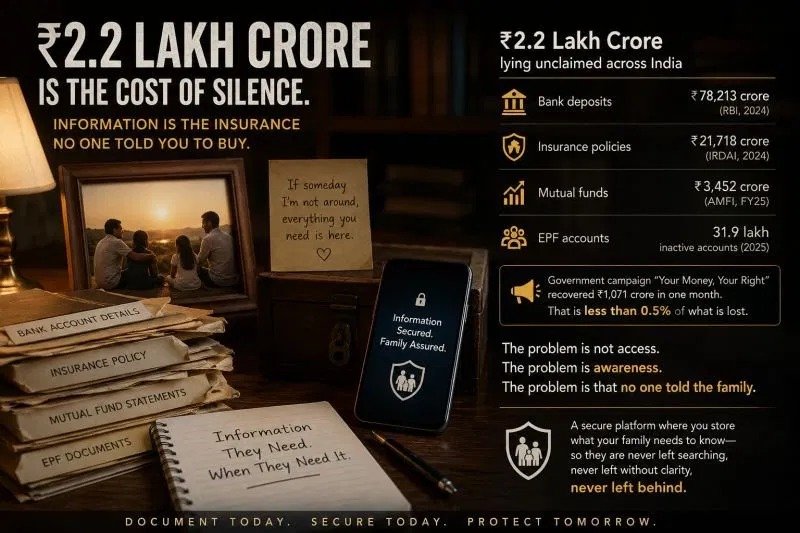
India is sitting on a financial crisis that rarely makes headlines. According to RBI data, unclaimed bank deposits alone exceeded ₹78,213 crore as of March 2024 — a staggering 26% jump in a single year. When you add unclaimed life insurance funds (over ₹25,000 crore), inoperative EPF accounts (₹8,505 crore), dormant mutual fund holdings, and unclaimed shares in listed companies, the total estimate of unclaimed financial assets in India surpasses ₹2.2 lakh crore.
This money has not been stolen. It has not been lost to bad investments. It is sitting in banks, insurance companies, and financial institutions — waiting. The families of the people who earned and saved this money simply do not know it exists.
A nationwide government initiative called “Your Money, Your Right” managed to return nearly ₹2,000 crore to rightful owners — less than 1% of what is lost. The Supreme Court itself questioned in early 2026 why a promised central database of unclaimed assets remains incomplete.
Why This Happens: The Information Gap
The primary reason families lose access to their own wealth is not legal complexity or institutional failure. It is something far simpler and far more preventable: one person knew everything, and they never told anyone.
Research consistently identifies the same root causes:
- Nominee details were never updated after marriage or the birth of children
- Investments made years ago were simply forgotten
- Cultural taboos around discussing money and death kept critical conversations from happening
- Families were unaware of accounts, policies, and assets held in the investor’s name
- Digital assets — email accounts, mobile phones, banking apps — were locked behind passwords only one person knew
The result is that a grieving family — already dealing with immeasurable emotional loss — must simultaneously navigate five separate government portals (RBI’s UDGAM, SEBI’s MITRA, IRDAI’s Bima Bharosa, the MCA’s IEPF portal, and EPF systems), gather extensive legal documentation, and often spend months or years trying to access wealth that was rightfully theirs from the beginning.
Introducing a New Category: Information Insurance
India has embraced financial insurance in all its forms — life, health, property, vehicle. Yet there is one category of protection that nobody offers and almost nobody thinks about: Information Insurance.
Information Insurance is not a product you buy from an insurance company. It is a practice — the deliberate, organised documentation of everything your family would need to navigate life without you. Bank account details. Insurance policy numbers and nominee records. Investment portfolios and their locations. Property documents. Passwords and digital access credentials. Your final wishes.
The philosophy is simple: the money is only as valuable as the family’s ability to access it. Financial security is incomplete if the access dies with the person who built it.
Digital Security: The New Frontier of Family Preparedness
As India rapidly digitises, the information gap widens. A decade ago, families could search physical documents. Today, critical information lives behind biometric locks, two-factor authentication, and encrypted cloud storage that only one person could open.
Consider what your family cannot access without your cooperation:
- Your smartphone — which receives every OTP needed to access banking, investment, and insurance portals
- Your email account — which holds statements, policy documents, and confirmation records
- Your demat account — which may require 6 months to 2 years to transfer even with a nominee
- Your EPF balance — one of over 31 lakh inactive accounts in India
- Your physical locker — whose location, key, and joint-holder details may be known only to you
The solution is not to avoid digital financial systems. It is to ensure that access to those systems is documented, secured, and transferable to the right people at the right time.
What Every Indian Family Should Do Today
Family preparedness does not require expensive professional services or complex legal instruments. It begins with a single conversation and a single document.
- List every financial asset you hold — bank accounts, insurance policies, mutual funds, EPF, property, and digital assets
- Update nominee details across all accounts and ensure nominees are aware of their designation
- Store access credentials — passwords, PINs, and security questions — in a secure but retrievable format
- Have the conversation your family needs: tell at least one trusted person where everything is
- Review and update this information at least once a year
Preparedness is not pessimism. It is not an acknowledgement of mortality or a morbid exercise in imagining the worst. It is an act of love — the highest form of caring for the people who depend on you. It means saying, without words, “Whether I am here or not, you will never be left searching.”
₹2.2 lakh crore is not just a number. It is the cost of silence. It is the accumulated result of millions of conversations that never happened, documents that were never organised, and information that died with the person who held it.
The question is not whether something will happen. The question is whether your family will be ready when it does.
About EternaSafe
EternaSafe Technologies Pvt. Ltd. is a DPIIT-recognised Indian startup building a secure, end-to-end encrypted digital vault designed to ensure that critical family information reaches the right people at the right time. Built on AES-256 architecture with zero-knowledge encryption, EternaSafe is developing India’s first platform dedicated to Information Insurance — ensuring that what you build in a lifetime is never lost to silence. Visit www.eternasafe.in | Follow @EternaSafe on Instagram