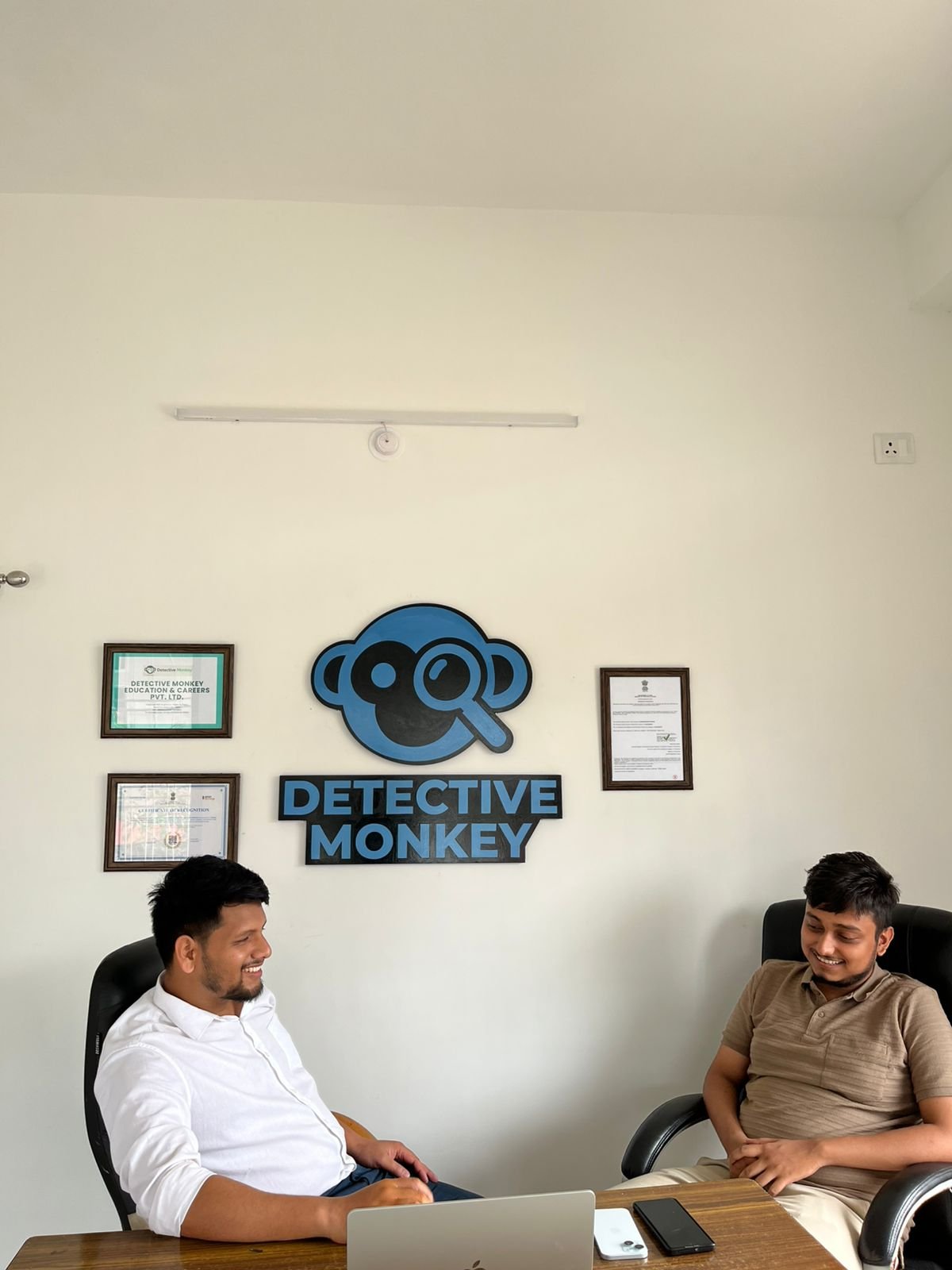
Saurabh Jyoti Dutta and Bhargab Sarma, the co-founders of Detective Monkey Education & Careers Pvt. Ltd., are quietly working on what could become one of the most important shifts in Indian education in decades. Their question is simple, and it has not had a satisfying answer in a thousand years. Why does India still decide a child’s entire future on a single number?
A child can be kind, curious, athletic, emotionally aware, morally grounded — and none of it shows up on the marksheet that determines where they study, what they pursue, and how the world treats them for the rest of their life. The founders believe this single-axis evaluation is the deepest crack in Indian education. They are not trying to invent a new system to fix it. They are trying to find the things that have always been there, and have never been measured.
Before writing a single line of code, they went looking for roots — studying India’s gurukul tradition where character, conduct, and physical strength were taken as seriously as academic command, and how Finland and Singapore measure children today. The conviction took shape slowly. India did not need a new philosophy of education. It needed to remember its old one, and give it the language and tools of the present.
That conviction became the ART Profile — short for Adaptive Reasoning Trajectory — Detective Monkey’s framework for understanding how a child actually grows, across three real-world dimensions: Academics, Behavioural, and Physical. Children do not grow in straight lines, the founders say, so the system measuring them should not pretend they do. Around ART sits the rest of the platform — a free School Management System, an admissions vertical called Campus Circle, and a single marketplace through which everything a school needs can flow.
“AI without real-world execution is worthless,” says Bhargab, an Information Engineering graduate from the University of Padova who returned home to build the company. The line shows up in everything they do. The team has completed a successful B2B pilot with more than ten private schools, and on the B2G side has been allotted three government schools in Bongaigaon for a pilot run under their Bongaigaon First initiative — a phase where the team is on the ground, learning how government schools actually function before anything is scaled.
The business side is where the story gets unusually interesting. Most edtech companies walk into a school and ask, “How do we sell more software here?” These two walked in and asked, “Who is the school actually losing to every day?” The answer is familiar to anyone who has run a school in India — chasing five vendors for a quotation, paying premiums on small cash purchases, no recourse on quality, and a principal who has slowly turned into a procurement officer instead of an educator. Detective Monkey’s marketplace fixes exactly this. Schools win on price, time, and quality. Local suppliers — the stationery shop, the smartboard vendor, the bookseller — get cleaner demand, digital reach, and a real shot at scaling. From a single pen to a full smartboard installation, every transaction flows through one trusted layer.
Once a school is on the platform, the relationship grows in directions edtech has barely begun to imagine — hardware, books, parent communication, admissions, fee financing, student insurance, a career engine built on years of real ART data, and eventually a job-market layer connecting students to verified employers. Each is a business on its own. Together, they are a school-to-career ecosystem India has never had.
The founders genuinely believe a trillion-dollar company can come out of India — not by importing Silicon Valley playbooks, but by respecting the galla, the principal, the parent, the supplier, and the child. “We are not building a starship to Mars or the Moon,” they say. “We are just trying to make every small thing a child does in a day finally count — every small effort that has been ignored by a linear evaluation system for the last thousand years.”
In that sentence sits the soul of the company — and arguably, the reason it could become India’s next great business, built quietly from the Northeast, on Indian terms, for Indian realities, with the patience to one day stand on the largest stages in the world.