
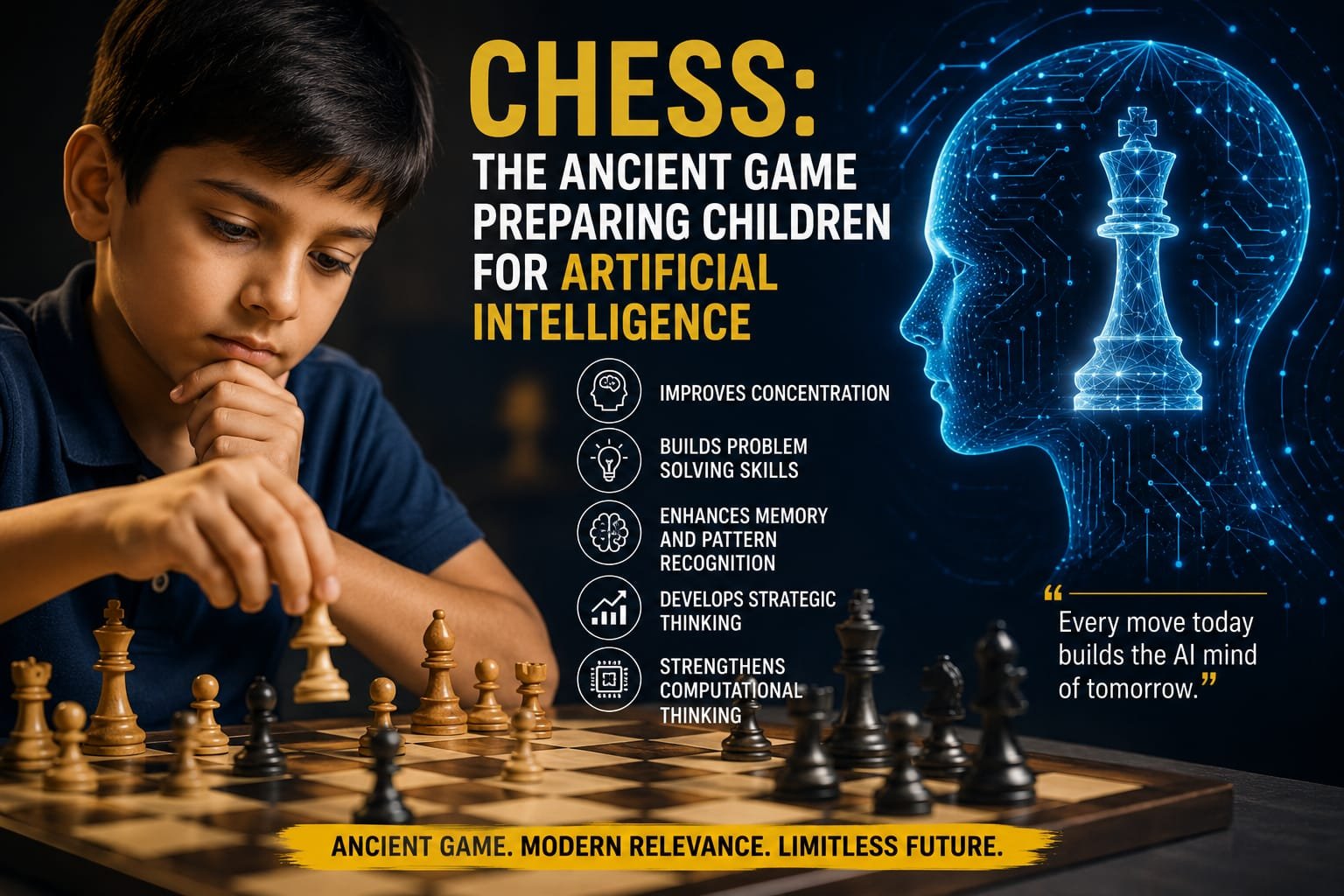
In a world progressively driven by Artificial Intelligence (AI), parents often wonder how to prepare their children for future careers. Many look toward coding classes, robotics kits and advanced technology courses. While these are valuable, the foundation of AI thinking may be found in a game that is over 1,500 years old: Chess.
At first glance, chess appears to be merely a board game involving kings, queens, bishops and knights. However, beneath its simple appearance lies a powerful training ground for developing the very cognitive skills that modern AI systems are designed to emulate.
Chess and Artificial Intelligence: An Unexpected Connection
Artificial Intelligence is fundamentally about decision-making. AI systems analyze situations, evaluate possible actions, predict outcomes and choose the most effective solution. Interestingly, this is exactly what a chess player does during every move.
When children play chess, they continuously:
- Analyze patterns
- Predict consequences
- Evaluate alternatives
- Solve complex problems
- Make decisions under uncertainty
These skills form the core of computational thinking, a key requirement in the age of AI.
The Brain Behind Every Move
A child playing chess is not merely moving pieces across a board. The brain is actively engaged in multiple cognitive processes.
Every move requires concentration and attention. Players must remember previous positions, recognize strategic patterns, anticipate opponents’ actions and formulate long-term plans. This strengthens working memory, logical reasoning and executive functioning.
Research has shown that regular chess practice can improve concentration, problem-solving abilities, mathematical thinking and academic performance. More importantly, chess teaches children how to think rather than what to think.
Pattern Recognition: The Language of AI
One of the most important abilities in artificial intelligence is pattern recognition. AI systems learn by identifying patterns within large amounts of data.
Similarly, experienced chess players recognize familiar board configurations and strategic opportunities. Children gradually learn to identify tactical patterns, positional structures and recurring game situations.
As they develop this skill, they become better at recognizing relationships, trends and solutions in other areas of life, including science, mathematics and technology.
Learning Strategic Thinking
Many children today are accustomed to instant rewards. Chess teaches a different lesson: success often requires patience and planning.
A strong chess move is rarely about immediate gain. Instead, players learn to think several moves ahead, evaluate long-term consequences and adapt when circumstances change.
These are precisely the skills needed in future workplaces where complex problems demand thoughtful analysis and strategic decision-making.
Chess and Computational Thinking
Computational thinking is widely recognized as one of the most important skills of the twenty-first century.
It involves:
- Breaking large problems into smaller parts
- Identifying patterns
- Creating logical sequences
- Testing solutions
- Learning from mistakes
Every chess game naturally develops these abilities. Children learn to analyze situations systematically, create strategies and continuously refine their decisions based on new information.
For this reason, many educators consider chess one of the earliest and most effective tools for developing computational thinking.
Human Intelligence and Artificial Intelligence
An important lesson of chess is that intelligence is not simply about finding the right answer. It is about creativity, adaptability and judgment.
Even the most powerful AI systems today can calculate millions of possibilities, but human players still contribute imagination, intuition and innovative thinking.
By playing chess, children learn how human intelligence and artificial intelligence complement one another. They understand that technology is a tool, while creativity and wisdom remain uniquely human strengths.
Why Schools Should Promote Chess
Schools seeking to prepare students for an AI-driven future should not overlook traditional games.
Chess is affordable, accessible and scientifically valuable. It requires minimal equipment yet develops critical cognitive abilities that support learning across multiple subjects.
Introducing chess clubs, classroom chess activities and inter-school tournaments can help students build concentration, resilience, confidence and analytical thinking.
Conclusion
The future may belong to Artificial Intelligence but the foundations of intelligent thinking can be developed through one of humanity’s oldest games.
Every chessboard is more than a battlefield of pieces. It is a laboratory of thought, a classroom of strategy and a training ground for the innovators of tomorrow.
As we prepare children for an progressively technological world, perhaps one of the smartest investments we can make is placing a chessboard in front of them and allowing them to think, explore and grow—one move at a time.
Dr. Nimish H. Vasoya
Centre of Toy Science
Advocate of Toy-Based Learning and STEM Education